Press "Enter" to skip to content

Category: wheelchairs

An Extraordinary Collaboration That Changed My Life

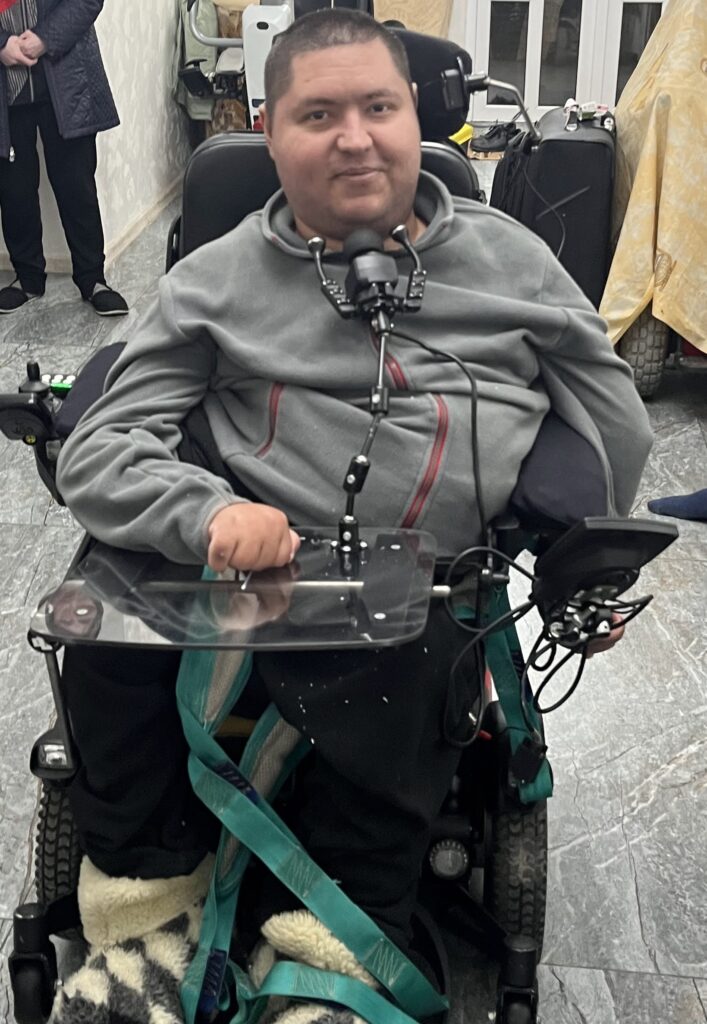
Andrei Cebotari in a power wheelchair with chin control, outdoors in a park on a sunny day
Andrei Cebotari using a power wheelchair with chin control during a walk in the park.

My journey began when I finally outgrew the wheelchair I had used every day for nearly twenty-four years. It no longer met my needs. My feet constantly pressed against the floor, causing severe pain, and as my neck muscles weakened, it became increasingly difficult to keep my head upright throughout the day. More and more often, my head would simply fall backward. I knew I needed a wheelchair with proper support, including a headrest.

We contacted the local social services, which provide standard wheelchairs every three years, hoping they could help. Unfortunately, they told us they did not have access to specialized equipment. Meanwhile, my old wheelchair was literally falling apart. The right axle had become bent, and it was obvious that I could not continue using it much longer.

Old manual wheelchair in heavily worn condition with torn upholstery and damaged armrests
The manual wheelchair I used for 24 years. Decades of daily use left visible wear on almost every part of the chair.

My mother convinced me that we would have to find a solution ourselves.

I started searching local forums and classified ads for used power wheelchairs. There were a few available in Moldova, but every one I found was in terrible condition. Some were heavily rusted, while others were missing important parts.

Since my father worked in France, I decided to expand my search there. The market was much larger, and I also had relatives living nearby. I made an agreement with my cousin’s husband: if I found a suitable wheelchair, he would inspect it and purchase it on my behalf.

I spent countless hours browsing listings on LebonCoin. Several promising Quantum models slipped away before we could finalize a deal. One excellent Invacare looked perfect, but it was located on the opposite side of the country, making pickup impossible. Around Paris and the surrounding region, most options were either extremely expensive or very outdated.

Eventually, I found a Permobil F3 located roughly 250 miles from Paris. My cousin’s husband contacted the seller, and everything initially seemed promising. Then, a few days later, the seller informed us that the batteries were dead. Traveling such a long distance without being able to test the wheelchair was simply too risky.

Fortunately, another option appeared: a Permobil F5 located only about twenty-five miles from my cousin’s home. He visited the seller the very next day and purchased it for me.

In the photos, it looked fantastic.

Only after the purchase did we discover that it already had 3,600 miles on it.

I was disappointed, but I had little choice. I needed a wheelchair.

That same evening, it was shipped to Moldova. Four days later, it arrived at my home.

I could hardly contain my excitement.

At the same time, I was terrified.

My right hand had become significantly weaker over the years, and I worried constantly about whether I would even be able to drive the chair.

When it finally arrived, they delivered it directly to our house. We immediately attempted to transfer me into it using a hoist.

The first attempt failed.

The upper lateral supports were positioned too high and too close together. The previous owner had been much thinner than I was. We decided to remove them, but even that became a challenge. My mother searched the house for tools and found a set of hex keys that barely fit. After a tremendous effort, she managed to remove one support. The second one refused to move.

She spent over an hour fighting with it.

We called a neighbor who promised to help but never showed up. After waiting for two hours, my mother went outside and asked another neighbor, a seventy-six-year-old man, for assistance.

At first he refused, insisting that he knew nothing about wheelchairs. Eventually he agreed to try.

For half an hour he struggled with the seized bolts. Nothing worked. Finally, he fetched a hammer.

I watched in absolute horror as he struck my newly purchased wheelchair with it.

Remarkably, the bolts finally came loose.

Afterward, he practically fled the scene.

Another neighbor later helped us adjust the backrest, and we tried once again to seat me in the chair. This time I could sit, but only on the very front edge of the seat. It was cramped, unstable, and extremely uncomfortable.

We stopped for the day.

The following morning, my mother watched YouTube videos and widened the chair by adjusting the armrests. Unfortunately, many of the adjustment bolts had rusted solid while the wheelchair sat unused in a garage. We still couldn’t position everything correctly.

When I sat down again, a new problem appeared.

The cushion was far too uncomfortable.

After twenty or thirty minutes, my left leg would go numb and intense pain would begin.

That marked the beginning of a long and exhausting struggle.

Every day we adjusted something. The headrest. The backrest. The seating position. The leg supports.

Nothing worked.

Without proper support around my pelvis, I constantly slid to one side and ended up pressing most of my weight against the armrest. Large bruises formed along my left side. I still could not tolerate more than thirty minutes in the chair.

I felt completely helpless.

The wheelchair that was supposed to restore my independence had become a source of pain and frustration.

Day after day, failure after failure, I sank into depression.

I couldn’t use the wheelchair.

I couldn’t properly use my computer.

I cried because I felt trapped.

Desperate for solutions, we began improvising.

An old transfer board that I no longer used was attached to the chair using wire and zip ties. The setup created additional support, but introduced new problems. Every time we needed to adjust the backrest or use the lift function, we had to remove and reattach the board.

Even then, the armrests dug painfully into my ribs.

We added furniture foam.

Then more foam.

Then pieces of fabric.

Little by little, the wheelchair began to resemble something assembled from spare parts and desperation rather than a sophisticated mobility device.

Every day my mother fought with heavy armrests, footrests, and stubborn bolts while trying to make life easier for me.

Watching her struggle broke my heart.

After nearly two months, I still could not sit comfortably for more than a couple of hours. We tried every cushion available. My old wheelchair had a curved, forgiving seat. The Permobil’s base was completely flat.

Nothing solved the problem.

And I still couldn’t drive.

Whenever I placed my hand on the joystick, it drifted to the right. I simply didn’t have enough strength to move it reliably.

I contacted the Romanian Permobil dealer, hoping for professional advice. Once they learned the wheelchair had been purchased unofficially, communication stopped.

I felt completely defeated.

We had spent nearly two months trying to adapt the wheelchair on our own. Every adjustment seemed to create a new problem, and every attempt ended in disappointment.

Out of desperation, I decided to write a post on Reddit. I wasn’t expecting much. I simply wanted to know whether anyone had faced a similar situation before, or if there was some solution I had overlooked. Looking back now, that post became the turning point of this entire story.

The original Reddit post that started everything is still available online:
Help! Can’t control my Permobil F5 joystick…

One person offered to design and 3D-print an attachment, but stopped responding shortly afterward. Most other advice boiled down to contacting local medical equipment suppliers—an option that simply didn’t exist in my situation.

Then something unexpected happened.

Liz Henry replied.

Liz worked with Grassroots Open Assistive Tech and shared contact information for several volunteer organizations. Liz also encouraged me to contact her directly.

I wrote a detailed email explaining my situation.

Their response changed everything.

Liz suggested a Google Meet call.

I was nervous because my English was far from perfect, but Liz invited her colleague Olga, who was originally from Moldova and could translate when necessary.

I couldn’t believe that complete strangers were willing to help me.

Soon Liz also invited Judi Rogers, an experienced occupational therapist.

During our call, I demonstrated how my hand slipped off the joystick and how difficult controlling the chair had become. At that point, I wasn’t even sure what movements I could still reliably perform.

Judi understood the problem almost immediately.

Within minutes she identified the seating issues and began discussing alternative control systems: mini joysticks, chin controls, specialized supports, and positioning solutions.

For the first time in months, I felt hope.

My dream was simple.

I wanted to regain enough independence to leave the house and walk my dog again.

Before long, our small group expanded. Liz connected me with Bruce Curtis and Levan Talakhadze from Easy Does It, an organization with extensive experience in supporting people with disabilities living independently. Levan is a professional wheelchair technician with years of hands-on experience.

Together they evaluated my situation.

Levan believed a mini joystick might work.

Judi suspected a chin-controlled system would become a reliable long-term solution.

Everyone agreed that proper lower lateral supports would be essential because of my posture and spinal curvature.

The idea of controlling a wheelchair with my chin sounded intimidating.

Then we encountered another obstacle.

Sending equipment alone wouldn’t be enough. Compatibility issues were likely, and there was nobody locally who could install and configure the system.

So the team made an extraordinary decision.

Someone would travel to Moldova.

Olga volunteered.

When I learned that her trip would take nearly eighteen hours, I was stunned.

While she prepared for the journey, we stayed in constant contact. The team sent photos of the equipment, discussed installation strategies, and helped me understand what to expect.

We developed two plans.

Plan A involved mounting a mini joystick on a tray that would support my arm.

Plan B was a chin joystick.

Eventually, Olga arrived.

I was excited.

I was terrified.

And I was desperately hoping this would finally work.

We immediately began testing.

Plan A failed.

Despite hours of adjustments, I still lacked the strength needed to reverse and turn reliably.

So we moved to Plan B.

The moment I touched the chin joystick, everything changed.

I nudged it gently.

The wheelchair moved forward.

It was effortless.

For a few seconds, I simply sat there in disbelief.

Then a realization hit me:

I can actually drive this.

The relief was overwhelming.

We continued refining the setup.

We redesigned the entire mounting system and built a rigid support connected directly to the armrest.

The next morning, we were ready for final assembly.

Then disaster struck.

The display reported a cable error.

For three exhausting hours we searched for the cause.

Olga pored over technical manuals. We checked every connection, every diagram, every component.

Nothing worked.

Out of desperation, we even called Levan despite the fact that it was four a.m. in his time zone.

We tested multiple joysticks.

We disassembled hardware.

We checked everything.

The same error continued to appear.

The possibility of failure began creeping back into our minds.

Finally, we tried one last approach.

We disconnected absolutely everything and rebuilt the entire system from scratch.

This time, the screen powered up perfectly.

The error vanished.

The feeling of relief was indescribable.

From there, everything finally came together.

Maintenance and adjustment of my power wheelchair
During the setup and adjustment of my power wheelchair to better fit my needs.

Olga programmed profiles, adjusted settings, positioned supports, and fine-tuned every detail. She had brought professional tools, programming equipment, an OMNI module, multiple joysticks, and everything necessary to complete the installation properly.

She even brought an Xbox Adaptive Controller so that I could play games during the long winter months when getting outside becomes difficult.

After three days of work, the moment I had dreamed about finally arrived.

My first independent trip.

Winter had only recently loosened its grip. Snow still lingered in places, and the air remained cold.

I rolled out of the house.

Then out of the yard.

Everything felt unfamiliar.

The chin joystick still required practice.

But I was moving under my own control.

We headed toward the park where I used to walk my dog.

Along the way, I encountered a broken section of sidewalk. To get around it, I had to cross muddy ground.

The wheels began sinking.

For a moment I panicked.

Then I corrected my direction, backed up, and guided the chair safely onto solid ground.

It may have been a small obstacle.

To me, it was a historic victory.

Driving my power wheelchair through the neighborhood during an evening walk
Enjoying an evening walk in my power wheelchair.

We enjoyed a wonderful walk.

My dog ran happily through the park.

And for the first time in a very long time, I felt free.

The next day, we completed the final adjustments.

Then it was time to say goodbye.

I was genuinely sad to see Olga leave. During those intense weeks of preparation and those few remarkable days together, we had become friends.

Looking back now, I understand something important.

When my mother and I were struggling alone—watching YouTube videos, forcing bolts loose, stuffing foam into gaps, and building improvised solutions—we were doing our best. But we were operating in complete darkness.

No amount of determination could replace expertise.

Without Judi’s clinical insight, Levan’s technical knowledge, Olga’s incredible dedication, Bruce’s support, and Liz’s ability to bring everyone together, none of this would have happened.

Some problems simply cannot be solved alone.

They require skilled people who know exactly what they are doing.

Today, I navigate my home and city independently. We removed thresholds inside the house for smooth riding. I continue gaining confidence with the chin joystick every day. Olga even developed a simple solution that improved grip by covering the joystick with a special mesh material, preventing my chin from slipping.

The wheelchair that once represented pain and hopelessness has become a symbol of freedom.

Bobby enjoying a ride on the back of my power wheelchair during an evening walk
Bobby enjoying our evening walk together.

Most importantly, this experience reminded me that kindness still exists in the world.

A group of strangers chose to help someone they had never met.

They gave me back my independence.

They gave me back my freedom.

And what began as a desperate search for technical assistance became something much more valuable.

To this day, Liz, Olga, and I still talk regularly.

The story didn’t end there.

What started as a search for technical help eventually opened an entirely new chapter in my life. Over time, Liz gave me an opportunity that meant far more to me than I can adequately express. She invited me to join her team at Grassroots Open Assistive Tech and trusted me with the role of system administrator for the Grassroots Open Assistive Tech website, openassistivetech.org.

For someone who had spent so long feeling dependent on others, being trusted with real responsibility was incredibly meaningful. It wasn’t simply a job. It was a chance to contribute, to learn new skills, and to give something back to a community that had already changed my life.

When I think about everything that happened, I realize that I gained much more than a wheelchair. I regained my independence, found new friends, discovered an amazing community, and was given an opportunity to build a future that once seemed impossible.

For all of that, I will always be grateful.

What began as a desperate search for a way to drive a wheelchair ended up changing my life in ways I could never have imagined.

1 Comment

The Battery Dilemma: From Lead-Acid to Lithium in Power Wheelchairs

Minimalist infographic comparing AGM, GEL, OEM, and LiFePO4 wheelchair batteries using a balance scale and a power wheelchair
Minimalist infographic comparing traditional lead-acid wheelchair batteries with modern LiFePO4 lithium battery technology for power wheelchairs.

Choosing the right battery fundamentally changes the experience of using a power wheelchair. As the grassroots assistive tech community pushes for the Right to Repair and hardware independence, the shift from traditional lead-acid to custom lithium builds has become a topic of great interest. Most power wheelchairs operate on 24V systems, typically using two 12V batteries connected in series.

Why I Started Researching LiFePO4 Batteries

Last August I bought a used Permobil F5. The original lead-acid batteries were in very poor condition — they could barely move the chair for a few meters inside the house. Around the same time, several people I know had already switched to lithium. One of them had been running LiFePO4 for over four years, while another had installed it just a few months earlier. Both kept telling me the same thing: with a proper lithium setup, you can often charge the battery only once a week, or even once every two weeks, if you mostly use the chair indoors.

This information really motivated me. I started researching whether it was possible to install a LiFePO4 battery in a Permobil F5. It turned out that quite a few people had already done this conversion successfully. I even spoke on a forum with someone from the United Kingdom who had built his own lithium pack for the same model. He described the dramatically increased range he now gets on a single charge. He also powers his non-invasive ventilator directly from the same battery. In his build he used eight EVE 160Ah cells — this specific size was chosen because the battery compartment in the Permobil F5 has very limited height, so larger cells simply wouldn’t fit.

Most LiFePO4 users I’ve spoken with feel the same way — they believe lithium is the future. They all say that the downsides are more than offset by the freedom it provides. Being able to travel 25–35 miles on a single charge without having to charge the chair every day, and without constantly worrying about damaging the battery, makes a real difference in everyday life.

To better understand why lithium makes such a big difference compared to traditional batteries, let’s first look at the main battery types used in power wheelchairs today.

Common Battery Sizes and Typical Range in Power Wheelchairs

Most power wheelchairs use two 12V batteries connected in series to create a 24V system. Batteries come in several standard physical sizes (called “group sizes”). The most common ones are:

  • U1 (Group 22NF): Usually 30–55 Ah. Common in lighter and more portable wheelchairs.
  • Group 24: Typically 60–85 Ah. One of the most widely used sizes for standard adult power wheelchairs.
  • Group 27: Often 80–110 Ah. Used in heavier-duty and bariatric chairs.
  • Group 34: Less common, but found in some larger models.

Important note on usable capacity: With traditional AGM and GEL batteries, it is generally not recommended to discharge them below 50% if you want to maintain a reasonable lifespan. This means that from a 74Ah AGM or GEL battery you can realistically use only about 35–37Ah. LiFePO4 batteries can safely deliver 80–100% of their rated capacity, so a 74Ah LiFePO4 pack can provide roughly 60–74Ah of usable energy.

Real-world range depends on the user’s weight, terrain, speed, temperature, and driving style. As a general guideline:

  • Good quality AGM or GEL batteries usually deliver 10–18 miles (16–29 km) of range.
  • Well-built custom LiFePO4 packs typically achieve 18–32 miles (29–51 km) in real conditions, with some users reaching 35–40 miles under ideal circumstances.
Comparison chart showing AGM, GEL, and OEM wheelchair batteries on a clean white background
Visual comparison of AGM, GEL, and OEM batteries commonly used in power wheelchairs and mobility devices.

Comparing the Main Battery Types

AGM (Absorbent Glass Mat) Batteries

This is the most common type. The electrolyte is absorbed in fiberglass mats. Popular examples include MK Battery in U1 and Group 24 sizes.

Pros: Good burst power, relatively low cost, provides natural ballast for stability.
Cons: Significant voltage sag when discharging, short lifespan (1–1.5 years), sensitive to deep discharge.

GEL Batteries

Similar to AGM but with the electrolyte in silica gel. Often positioned as a premium lead-acid option (examples: MK Battery GEL, Sonnenschein).

Pros: Better cycle life than AGM, slightly more tolerant to deep discharge.
Cons: Very sensitive to charging voltage, poor cold weather performance, higher price.

OEM (Factory Branded) Batteries

Batteries sold by wheelchair manufacturers (Permobil, Pride Mobility, Invacare etc.). In most cases these are rebranded AGM or GEL batteries.

Pros: Perfect physical fit, usually maintains warranty.
Cons: Significantly more expensive (“brand tax”), sometimes include software locks (DRM).

Blue LiFePO4 prismatic battery cells arranged in a multi-cell battery pack configuration
LiFePO4 prismatic cells commonly used in custom lithium battery builds for power wheelchairs and mobility systems.

The Lithium Upgrade (LiFePO4)

Lithium Iron Phosphate (LiFePO4 or LFP) is one of the safest and most practical lithium battery chemistries available today. Unlike conventional lithium-ion batteries (such as NMC or NCA), LiFePO4 uses iron phosphate as the cathode material. This makes it significantly more thermally stable and much less prone to thermal runaway (fire or explosion) even if the battery is damaged, overcharged, or short-circuited.

Because of its safety characteristics and long cycle life, LiFePO4 has become the preferred chemistry for custom power wheelchair builds and is increasingly being offered as a factory option by some manufacturers (for example, Ottobock on the Juvo series and Pride Mobility on the Jazzy EVO 613Li).

What is a BMS?
BMS stands for Battery Management System. It is the electronic “brain” of a lithium battery. It constantly monitors voltage, temperature and current, protects the battery from overcharging, deep discharging, overheating and short circuits, and balances the individual cells so they work evenly. A good BMS is essential — without it a lithium battery can be damaged or become unsafe.

How a LiFePO4 battery is built

A typical 24V LiFePO4 battery for a power wheelchair consists of 8 prismatic cells connected in series (each cell has a nominal voltage of 3.2V). High-quality cells from manufacturers such as EVE or CATL are most commonly used. These cells are connected to a BMS, thick power cables, appropriate fuses or circuit breakers, and are securely mounted in the battery compartment.

Pros:

  • Comparable upfront cost with much better long-term economics: A quality LiFePO4 build with a good BMS usually costs about the same as a pair of premium GEL batteries, but lasts significantly longer (often 5–10 years).
  • Radical weight reduction: A well-built 24V LiFePO4 pack typically weighs 25–35 lbs (12–16 kg) instead of ~100 lbs (45 kg) for a lead-acid pair.
  • Flat power curve: The wheelchair maintains strong and consistent performance even at lower states of charge — there is almost no voltage sag.
  • Much higher usable capacity: You can safely use 80–100% of the rated capacity, compared to only ~50% with AGM/GEL batteries.

Cons:

  • Requires proper assembly: Needs correct calculations, heavy-gauge wiring, quality circuit breakers (100A+), proper fusing and good insulation.
  • Dedicated charger required: Standard lead-acid chargers will damage the BMS and cells. A lithium-specific charger is mandatory.
  • No gradual warning: Because there is almost no voltage sag, you get very little advance notice before the BMS cuts power.
  • Air travel restrictions: Lithium batteries are subject to strict IATA and airline regulations. Many carriers require advance notice, battery removal or special packaging.

The Problem with Off-the-Shelf Lithium Batteries

Buying cheap ready-made 12V LiFePO4 batteries (sold for RVs or solar, such as generic “100Ah RV batteries”) is a common mistake. Most budget batteries have weak BMS boards (often limited to 30–50A continuous discharge). Power wheelchair motors create very high current spikes on startup. A weak BMS interprets these spikes as a short circuit and instantly cuts power — leaving you stranded.

Commercially available batteries with sufficiently strong BMS boards are very expensive and often too large for standard wheelchair trays. For most users, a properly engineered custom build remains the only practical solution.

Important Safety and Usage Notes for LiFePO4 Builds

  • Check your current draw: Before choosing a BMS, determine the continuous and peak current consumption of your wheelchair’s motor controller. Many controllers can briefly pull 80–150A or more during acceleration and hill climbing. Select a BMS and circuit breakers with adequate headroom.
  • Discharge limit: Never discharge below 20–25% remaining capacity. Always keep a safety buffer — the BMS will cut power abruptly with no gradual slowdown.
  • Quality BMS: Use a BMS with over-current, short-circuit, temperature and cell-balancing protection.
  • Fusing: Always install appropriate circuit breakers or fuses (100A+ class recommended).
  • Secure mounting: The battery must be firmly fixed — wheelchairs experience significant vibration.
  • Professional help if needed: Improper assembly can damage the motor controller or create a fire hazard. If you lack experience with high-current DC systems, work with a knowledgeable technician.

The Hidden Trap of Losing Weight: Center of Gravity and Traction

One of the biggest advantages of a custom LiFePO4 build is the dramatic weight reduction. However, removing 60–80 lbs (27–36 kg) from the base changes the wheelchair’s physics:

  • Loss of traction: Drive wheels need downward pressure. Without the original ballast the chair can spin its wheels on smooth ramps or wet surfaces.
  • Higher center of gravity: This increases the risk of tipping, especially during quick acceleration or on slopes. Many users add bolt-on counterweights or adjust seat positioning to restore stability.

Conclusion: Making the Right Choice

Switching batteries is not just a component swap — it changes how your wheelchair feels and behaves.

If you want maximum simplicity and minimum hassle, high-quality AGM batteries (such as MK Battery) or premium GEL options remain the most straightforward traditional choice.

However, if you want to eliminate voltage sag, significantly reduce weight, increase range, and are willing to invest time or professional help into a proper build, a well-engineered custom LiFePO4 pack using quality cells (EVE, CATL, etc.) is usually the best long-term investment. The key is to approach the project responsibly — never compromise on BMS quality, always use proper fusing, respect the new physical dynamics of a lighter chair, and leave a safety buffer on every charge.

This article is for informational purposes only. Modifying batteries may affect warranty, safety certifications, and medical device compliance. Always consult with your wheelchair provider or a qualified technician before making any changes.

Leave a Comment

Events this week! Tune Up & 3D printed tools

Our next Tune-Up workshop will be May 5 at the Disability Cultural Center! Register at https://disabilityculturalcenter.org

And, while this isn’t a GOAT sponsored event we want to promote the ILRCSF’s accessibility tools event the next day, on Wed. May 6 — It’s another “drop-in” style afternoon where you can come in and try some 3D printed assistive technology tools. These are often printed from free, open source designs, which means they can be easily customized to fit your needs!

3D Printing for Independent Living


Leave a Comment