Great news! GOAT was awarded a Community Impact Grant from Ability Central! We are using this grant to expand our wheelchair maintenance workshops. Our April, May, and June Tune-Up Tuesdays are funded by the Ability Central grant!
At our workshops, around 10-15 people per event get a free inspection, a small portable toolkit to attach to their chair or carry in a backpack, and a worksheet to take with them with information about the chair. We look up service manuals so that wheelchair users can better understand how to prevent, troubleshoot, or fix small problems, and how to figure out what’s needed for more complex repairs.
The Independent Living Center SF and other Bay Area organizations, like the CIL and Easy Does it Services, collaborate with us as well as volunteers from the DCC staff and Streets Forward.
We believe that understanding maintenance helps keep people mobile, empowered, and engaged in their communities. We depend on our gear to get us around the house, out of the house, just to live our lives and have control over what we do. When our devices break, the path isn’t clear at all, and it isn’t easy even for people who bought their devices new and have insurance or warranty coverage. For people with secondhand, donated, or older equipment, the problem is even worse. What happens to everyone, I find, is that we end up in “loaner” or donated chairs, or an old half broken one we’ve had for years. That can mean pain or injury, and usually means serious limitations on what we can do. Life is on hold when we can’t get around!
Added to that problem, repair people with experience are rare. It’s as if there were no small bike shops, bike collectives, car repair shops, and you always had to go to “the dealer” for your fix. We’re hoping to change that, and bring some of our wheelchair user “customers” and our volunteers together in a way that leads people to develop a better and more robust ecosystem for repair and reuse! At our back, in California, we have right to repair legislation – including the Powerchair Repair Act from 2025 – defending our abilities to maintain and repair the tech that we own.
With Ability Central’s generous grant, we’ve bought supplies for many more free toolkits! We’re also able to contract time when needed to fabricate (often via 3D printing) small parts for modifications and enhancements.
Here’s our kit assembly volunteers, this weekend in my garden!
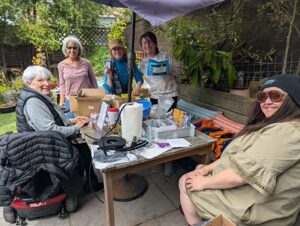
It was amazing to bring this crew (which overlaps with our Tune Up and Archiving volunteers) together again. This version of the kits has a really good adjustable wrench, a flat multi-wrench for holding bolts/ nuts along with the main wrench, a double headed screwdriver, cleaning cloth, small bottle of tri-flow lubricant, a mini sewing kit, and useful fasteners like velcro straps, gaffer tape, and heavy duty cable ties. It’s meant not only for routine maintenance and creative modifications, but for emergency repair — you never know when a cable tie and some tape is going to save you on the street!
In late April, we ran an extra Tune Up event at a Mutual Aid swap meet event in Berkeley that was focused around donations of medical equipment. Here, you can see Olga taking apart a rollator on the sidewalk at the Mutual Aid event, to give it some tender loving care. We removed enough hair from the wheels to create a whole new pet and we fixed the brakes so that they work again.
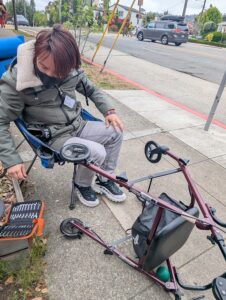
The rollator’s owner was scream-laughing with horror at how much hair came out of just one wheel axle! I wish I had a photo of her clapping with excitement at how the rollator didn’t just escape down hill when she set the (newly fixed) brakes. But it is burned into my brain as a lovely memory!
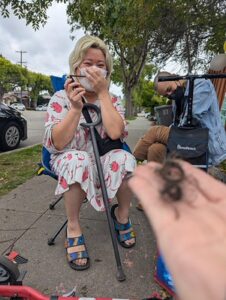
Here’s some nice pictures by Aaron from Streets Forward, of one of our previous Tune-Up events at the Disability Cultural Center. It took a whole group of us to figure out what was going on with this manual chair’s quick release wheel!
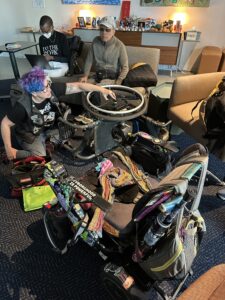
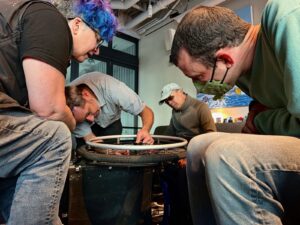
Our experience so far with these community events is that we can’t solve every problem on the spot. But what we’re doing is beyond sharing tools and manuals. We are demonstrating the process of troubleshooting and diagnosis. We don’t take the machine away from its owner and work on it in a back room out of sight. It’s something we approach together and so the chair owners learn that no matter what your experience, you don’t know everything from the start, you have to kind of experiment, try different things, come up with a hypothesis and test it. What’s causing that grinding noise ? We can test some things and find out. It is an approach that rejects authority and hierarchy, a rejection of the ways that secrecy hoards power. Instead, we share knowledge and hands on empowerment, even when, or especially when, we don’t know all the answers!
That open, experimental, hacker’s attitude is part of the energy we put into our disabled community! And it’s a critical part of disability culture — we have to take control of what we can, improvise, and work together in a world of uncertainty.
From my records, we “fix” about a third to a half of the devices people bring to our events. Another good chunk of the issues that crop up need follow up and referral. For those cases Vincent and Angello from ILRCSF have been able to help people effectively! That can mean help calling their device vendor, manufacturer, or working with them to get insurance to cover replacement parts. We also work with other Bay Area orgs who generously share their expertise and spare parts, and who handle follow up with people who come from other towns to our San Francisco events.
There are a small handful of folks who need us to really hustle and do extra to be on their side, and I’m proud to say that along with the orgs I’ve mentioned, GOAT has helped three young people who had nowhere else to turn, to get refurbished, donated powerchairs. This is close to my heart because years ago, I was in that situation, without any support, upset and terrified at the loss of mobility I was experiencing, and because of another wheelchair user who gave me their old chair, it was just life-changing, and helped me figure out how to get to a more stable situation. It is good to give some of that back into the world.
For the next couple of months — We will be planning extra events at locations in the East Bay for May, June, and July, and we are expanding our collaborations to work with MELP on the Peninsula!
Here’s more ways to find out about our wonderful grant sponsor, Ability Central:
-
LinkedIn: @Ability Central
-
Facebook: @Ability Central
-
Instagram: @weareabilitycentral
-
X: @AbilityCentral
-
Website: https://abilitycentral.org