Press "Enter" to skip to content

Category: archives

Building simple switches

In the material we are scanning from Alexandra Enders’ collection of DIY assistive tech information, we have come across several great sources for learning the basics of electronics in order to make switches, buzzers, and other small gadgets, very useful for people with limited dexterity to control other devices.

I really like these short, practical guides. Rather than having to wade through a college textbook level guide to electronics, you get just the basics you need to build very cheap and easy gadgets.

Today’s scan is simply called “Introduction to Electric Circuits”, written in 1981 by Hugh O’Neill from the Rehabilitation Engineering Center at Stanford.

He explains what a circuit is – an unbroken path from one terminal to another of a power source, through which current can flow. A good overview of circuits in series and parallel comes next, including the tip that most simple toy adapters the AT maker will build, will be in series.

Types of switches covered are toggle, rocker, push button, microswitch, rotary, and mercury (tilt) switches.

It’s a very condensed electronics course in about 15 pages! If you walk through it and try the instructions, you will learn enough about how batteries, switches, circuits, and so on work that you can build many adaptive devices.

Have a look: https://archive.org/details/introduction-electric-circuits
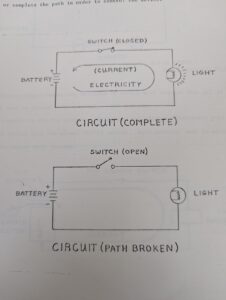
a diagram showing a complete and a broken circuit

Leave a Comment

Adding metadata to individual device entries

The DIY information that the GOAT team has been scanning and cataloguing is in book-sized chunks right now. So, you can go to the Internet Archive to our scanned material, and search on a term — for example, “woodworking“, or “clothing” and you’ll be able to view the entire book. 

Our goal, though, is to be able to search for individual devices. Our next project is to pull out those devices and add metadata to them. We’re testing that now on a small scale! Check out the DIY Big Index page. While there are only a few devices there for now, you may be able to see the potential! 

We will end up with an easy way to search for every record we’ve got on how to build a standing frame, a fork extender, or a cup holder. Anyone can then comment on the designs, add photos or links to videos, and so on, to show their own builds and contribute improvements, variations, and other suggestions. 

Those entries don’t have to be limited to information we’ve scanned. We can index and host archive copies from other sources too, and include open source software and hardware projects, like those from OpenMedTech or Open Source Wheelchairs!

We will be hosting an event soon to invite volunteers to help us categorize and label devices. If you’re interested, please comment here or email liz@openassistivetech.org!


Leave a Comment

Archive scans: Punk on crutches in a clothing DIY book

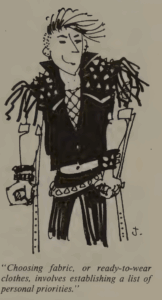
ink and pen illustration of person in punk rock gear and a mohawk, with forearm crutches
“Choosing fabric, or ready-to-wear clothes, involves establishing a list of personal priorities”

In our recent scanning and archiving work, I really loved this illustration from a 1987 book, Fabricwise,  on issues to consider when choosing fabrics for adaptive clothing. Really, it’s a good short primer on the pros and cons of different kinds of fabrics and why you might choose them in particular situations.

You might want to think about the tradeoff between a little bit of stretch for your pants if you are sitting in a wheelchair (good for comfort and not having baggy pants; bad for durability).

A quote from the introduction:

An able-bodied person may be able to tolerate clothes made from fabrics which are less than comfortable, crease badly or need a lot of care. For the person with disabilities, any one of these drawbacks, discovered too late, may mean that the clothes are hardly worn.

Correctly chosen fabrics can help minimise some of the problems of people with disabilities; a wheelchair cushion covered in a fabric with a high pile or rough finish may contribute to sitting stability while one with a fabric surface which is smooth may make wheelchair transfers easier. Warm yet lightweight bedding can make sleep more comfortable and getting in and out of bed easier.

It has a lot of ideas like this that seem like common sense when you think about it – but that many people have to find out for themselves. I never thought about using a rougher wheelchair cushion fabric to stop myself from sliding around, but now I want to try it!

Sadly, the book does not magically solve the problem of jacket cuffs fraying on one’s manual wheelchair tires.

But I appreciate the punk representation!!

Leave a Comment