Our Bay Area Repair Coalition summit went really well! We got a last minute offer of food and travel funding from OSHWA/Open Healthware, which meant we could offer our 25+ BARC attendees lunch rather than just drinks and snacks. We also flew out last minute special guest Erik Kondo, open source wheelchair designer and builder, and planned a day long event at GOAT Space the day after BARC met. I’ll report here on BARC and then in our next post will cover the open source wheelchair build day!
Here’s a link to all the photos from both days: https://www.flickr.com/photos/lizhenry/albums/72177720335150575
Thanks to GOAT crew and my partner Danny, we made ourselves a cozy meeting space in the big conference room at the Ed Roberts Campus building in Berkeley. Danny ran our A/V and streaming setup and also took amazingly great notes. My notes combined with his notes are available if anyone would like to read them.
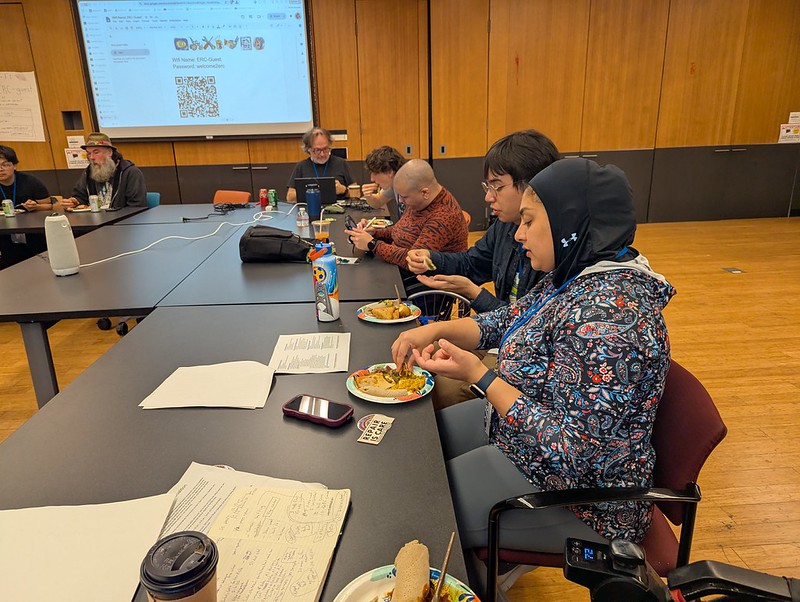
From years of tech conference going and speaking, I am an aficionado of loosely structured unconference style events. Everyone also seems to like the “hallway track”, a term that refers to how the best parts of a conference are sometimes the chance discussions you have in the hall or between events. So we started with an hour for lunch together. This also meant we gave stragglers time to show up, and they would not miss the “official” start. Discussions were too lively and varied for me to track but I was so happy to see people meeting each other for the first time, or re-meeting after years!
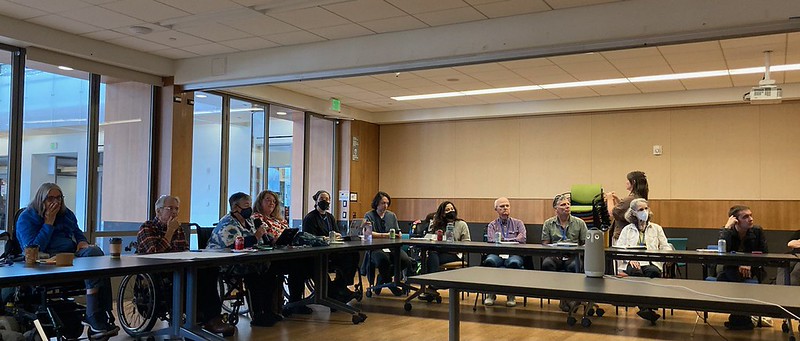
We then had a brief go-round the room for introductions and where you work, what you do. After that, a second round robin for talking about your work and issues that come up for you. This became in a lightly facilitated discussion, returning nicely to our “go around the room” structure.
With 10 minutes to go till the planned break at 3, Corbett O’Toole gave a talk, A Life of Hacks, talking about some of the different adaptive devices she has needed, designed, and built in collaboration with others over the years. She is an expert at accessible RV and bus living, and at making adaptive stuff out of cheap things from a hardware store and scavenged parts. Her perspective on hacking, making, and designing for adaptability and repairability is always valuable. I hope GOAT will do more talks and events with her!
Slides: A Life of Hacks
Text: A Life of Hacks script
Our 15 minute break became such a successful and lively “Hallway Track” that I did not have the heart to interrupt it. I remember Danny and I exchanging a telepathic glance, then muttering to each other that we should let the unstructured conversations flow. Anarchist facilitators slipping into goblin mode! With only half an hour left till our planned ending time, I called people back to “order” and we had a final go-round to mention anything unmentioned, or a take away point or next step they have in mind.
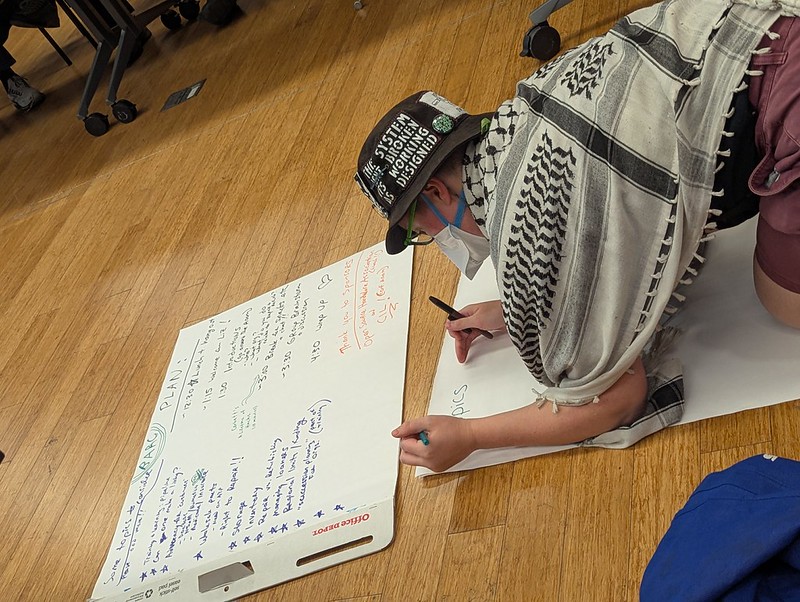
Here are some ideas for action that came up during the discussion.
. I think this is already happening, unstructured, but from email responses and follow up conversations I have the sense that I or GOAT should step up to declare or bless some “open house” tour dates.
This was an idea bandied around a bit. Community members could agree to be decentralized storage. BARC could have a tracking system so we know where the chairs are kept. For our “working but not placed” chairs but could also be for a wheelchair user’s backup chair that they can’t store. Many people have limited, or no, space in their home (even if they are housed securely).
This is a big problem. Many of us are already unofficially sharing inventory and passing donated chairs around. Could we share a warehouse storage space? Could we afford a van to transport for pickup and dropoff of donated chairs? Will a local municipality, maybe, give us free or extremely cheap space to store something like 50 powerchairs?
A person puts in their city, and then has a checkbox to consent for their request to be visible to all the BARC orgs. That way we can figure out who can help them and who has what they need. (That may be different orgs!) Could we use ReCares’ system of Google forms? For both DME requested and available for donation.
Treating our needs as part of transit could be possible. MTC funds breakdown support for highways. We could make a case for wheelchair breakdown service !
Waivers or some boilerplate legal templates to ameliorate potential repairer’s liability fears. Maybe some legal support.
Is there a viable path to people starting independent repair shops or businesses? that’s part of the point of recent Right to Repair legislation. We can enter coalition with bike repair people for example. But can a person make a living?
How to get the wheelchair with the functionality you need, and get insurance or medicare to pay for it? We could cross train in this.
Could we start a program to get more rollators out there in lieu of the low end walkers people get at the hospital? Can we just build some, cheaper and more easily repairable, out of PVC, decent wheels, and brake assemblies?
Ways we could work with local hospitals/rehab/OTs? Kaiser?
For simple DIY maintenance. Videos, posts, email newsletter, physical magazine, workshops. Zines, handouts.
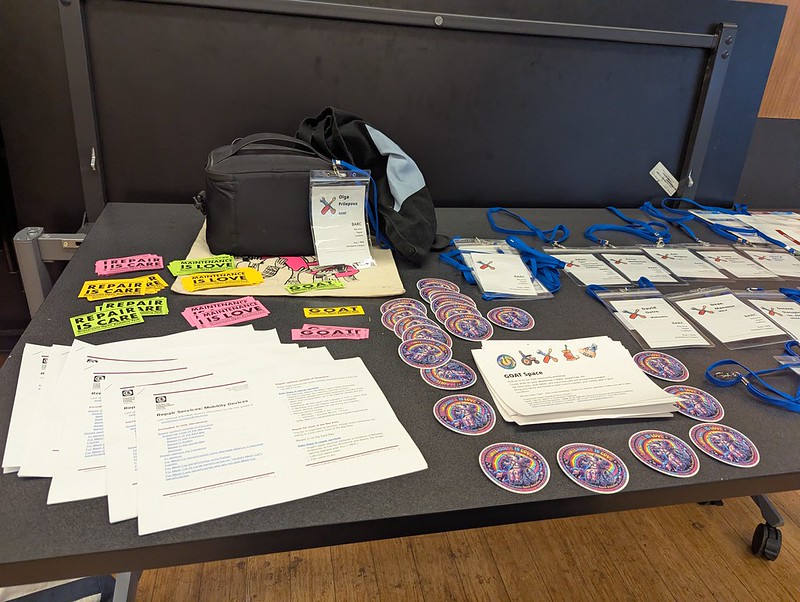
With lanyards and badge holders left over from OSHWA’s Open Healthware conference, I whipped up cute looking name badges. We also ended up printing out “Repair is Care” and “Maintenance is Love” stickers on laser printer sticker papers. My years of zine life come in handy. People seemed surprised by the air of legitimacy conferred by BADGES. It is like the “front matter” and dust jackets of a book, just create a flurry of material around your event and it starts to become real in people’s minds. I loved seeing people take all the stickers!
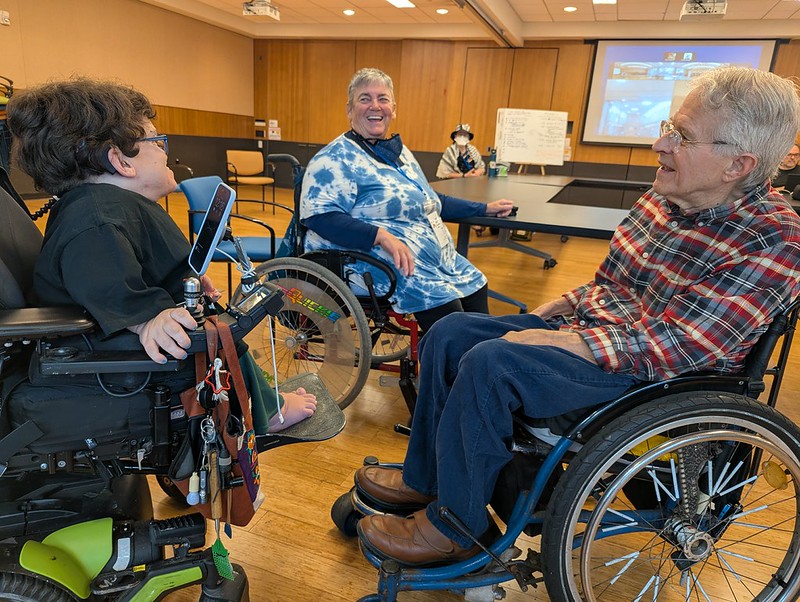
Another great pleasure for me during this event was getting to put people I like and admire in the same room. What happens next is unpredictable, like the spiral paths in a cloud chamber when you have banged things together in a particle accelerator. Seeing Erik roll up in his custom built PVC pipe wheelchair, to meet Ralf Hotchkiss of Rough Rider and Whirlwind Wheelchair International, made me instantly happy in a way I can’t quite describe. And I want people who are so staunch as to be legendary, like John Benson, to be and feel supported, loved, and part of a group rather than the one critical piece in a ramshackle structure about to fall over (which is kind of how the community treats him to be honest).
But above all I felt very happy that the energy in the room built on itself in a way that I think will fuel our desperately needed movement for disabled peoples’ uninterrupted access to appropriate, well maintained, mobility equipment. All of the organizations I know of doing this work, and individuals too, come to it because it is needed and they cannot help but gravitate towards doing what clearly needs to be done. We can build enormous momentum together and gather strength and gather more people to not just learn skills but make a collaborative and sustainable way of doing this work, that others can replicate.
We shared the full notes with all the invitees, so let me share them with you too!
If you would like to support more BARC action and what GOAT is doing, please donate money to help us in our work! We appreciate any level of help – direct donation or you can subscribe to our Patreon with a monthly donation! We welcome corporate matching funds via Benevity and OpenDoor or really, any others you suggest.