Press "Enter" to skip to content

Category: DIY

TechOWL and ATAP programs

There are a lot of programs for improving access to assistive tech at the state level, often supported by universities and independent living centers. TechOWL at Temple University in Pennsylvania is a great example, with tons of resources and material if you want to learn about AT options. It stands for Technology for Our Whole Lives. (We love a cute acronym here at GOAT!)
Resource centers like TechOWl exist in part in the U.S. because of support from the Assistive Tech Act of 1988.

Every U.S. state and territory has a mandate, and state funding, to give people access to learning about, trying out, and obtaining assistive tech via an Assistive Technology Act Project (ATAP).

They all do four things :

  • Lending library for assistive tech
  • Used equipment program, often run by a group of contractors or vendors.
  • Presentations and trainings, workshops
  • Consults and demos for people to problem solve and explore AT

So, TechOWL is the ATAP for the state of Pennsylvania.

A few years ago, because they had a staff member with some expertise in 3D printing, they started the CreATe Together project for 3D printing assistive tech. That has grown to become a well supported program with an online catalog of standard devices you can request (if you live in Pennsylvania), and they’ll find a partner to make it for you. They also can handle some custom requests.

It is an interesting model that I’d like to see more of in California, where we have Ability Tools as the main ATAP program, with a strong focus on reuse but not a lot of “maker” activity that I’ve found.

The level of AT you can make with a 3D printer seems a bit limited. In the TechOWL catalog we see mostly small gizmos that can help a person with grip strength or dexterity problems. This makes sense on one level because for AT that has a more critical function there could be quality control safety risks that a state funded program (with an array of loosely associated fabrication shops or volunteers with home workshops) is not prepared to handle.

On the other hand I could already use a bunch of these little plastic gizmos. A thing that punches pills out of those annoying blister packs? Hell yeah!

You can see a slightly wider array of 3D printable devices on sites like Printables or Creality – or the Internet Archive’s backup of older Thingiverse models.

It would be very interesting to go through all these sites and categorize the types of assistive tech that we can find there!

Leave a Comment
Building simple switches

In the material we are scanning from Alexandra Enders’ collection of DIY assistive tech information, we have come across several great sources for learning the basics of electronics in order to make switches, buzzers, and other small gadgets, very useful for people with limited dexterity to control other devices.

I really like these short, practical guides. Rather than having to wade through a college textbook level guide to electronics, you get just the basics you need to build very cheap and easy gadgets.

Today’s scan is simply called “Introduction to Electric Circuits”, written in 1981 by Hugh O’Neill from the Rehabilitation Engineering Center at Stanford.

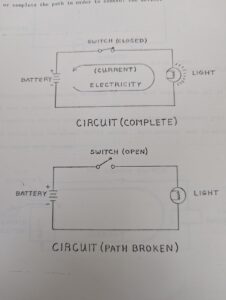
He explains what a circuit is – an unbroken path from one terminal to another of a power source, through which current can flow. A good overview of circuits in series and parallel comes next, including the tip that most simple toy adapters the AT maker will build, will be in series.

Types of switches covered are toggle, rocker, push button, microswitch, rotary, and mercury (tilt) switches.

It’s a very condensed electronics course in about 15 pages! If you walk through it and try the instructions, you will learn enough about how batteries, switches, circuits, and so on work that you can build many adaptive devices.

Have a look: https://archive.org/details/introduction-electric-circuits

a diagram showing a complete and a broken circuit

Leave a Comment

Love Your Ride – wheelchair maintenance and repair workshop

GOAT is running another free workshop in San Francisco, at the Independent Living
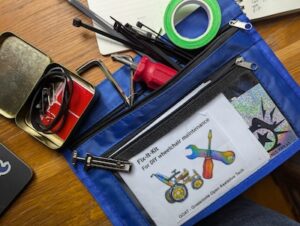
Resource Center SF! In honor of Valentine’s Day we are calling it “Love Your Ride”. At this event we will test out our pilot Fix-It-Kits, which are small pouches of tools and materials, along with a pocket sized zine.

The zine has a workbook page to record useful information about your mobility device, and then goes through inspection, cleaning, checking vulnerable points like all bolts, screws, wheels, folding parts, and attachments. Collecting that info will help us construct a custom kit, with replacement bolts, tools for tightening bolts and screws, and so on.

a colorful zine and some tools coming out of a zippered pencil pouch

Free workshop to learn maintenance for your mobility gear
Wheelchairs, powerchairs, scooters, walkers, rollators, etc.

Time: Saturday, Feb. 22, 2:00pm – 4:00pm
Location: ILRCSF, 825 Howard Street – San Francisco

FREE TOOLKIT AND INSTRUCTION MANUAL

We will work with you to make a custom maintenance and emergency repair kit!
You will get to take home a small, portable bag with tools and materials customized for you.

There is also a workbook to fill out with information about your mobility device or devices.

We will look for service manuals and other information to give you as well!

Please register by emailing Brianna@ilrcsf.org with your name, phone number, and any particular access needs you have. Or you can call or text Vincent @ 415-609-2555 if you prefer that to email. We’d love to see you there!

A joint workshop by Grassroots Open Assistive Tech and ILRCSF
Liz Henry, liz@openassistivetech.org, https://openassistivetech.org
Vincent Lopez, vincent@ilrcsf.org, https://ilrcsf.org
Marisol Ferrante, marisol@ilrcsf.org, Nick Feldman Assistive Tech Lending Library

Leave a Comment