Press "Enter" to skip to content

GOAT Posts

Adaptations on the street

I’m always fascinated by talking with other wheelchair users about the ways they customize and add attachments to their devices. Usually that means a lot of clips, bags, backpacks, pouches, velcro, cable ties, and so on. People develop a whole system of what to store where, depending on how they use their chair and how far to the side or back they can reach.

The other day on the bus I was chatting with the guy in the wheelchair spot across from me. I’ll call him “Kez” for anonymity! His chair was a very beat up, basic “hospital chair”, a heavy folding x-frame chair with a sling seat. He was super friendly and nice so I had to ask him why he had thin twine strung back and forth under his seat. It was quite thin and breakable looking, and a bit chaotically strung, like a net or web woven without much concept of creating a regular pattern. He explained that even though the string – almost thread! was so thin, it was still useful for carrying groceries or blankets under the seat. I offered to find him a bungee cord or two but he said no. Apparently a shelter where he stays doesn’t allow thicker string or rope or bungies, because it is considered a suicide risk.

Honestly this shocked me a bit! I am very curious to talk with him again and find out more details. I also want to talk with some shelter staff and find out more about their policies. If I could learn their rules then maybe I can think of some improvements that people like Kez can use. And I’m talking with other folks like C.R.I.P.S.R.I.S.E. about doing a sort of rolling survey, a bit more formalized, to find out what assistive tech help people in Kez’s situation might find useful. We can’t solve every problem a person on the street faces, but we could get a better idea of how to merge their DIY techniques with our expertise and resources to be of more practical help.

People with insurance and doctors have one set of problems in getting and maintaining their mobility gear; people dealing with Medicare have extra layers to that. Unfortunately, for everyone on the street in my city I’ve talked with there are orders of magnitude more problems. Literally “hacks” like tying one’s manual chair to one’s leg with rope so it is less likely to be stolen in the night.

A depressing reality. But it’s testimony to people’s creativity and DIY ingenuity to help themselves and their friends to survive.

Our second batch of “Fix It Kits” are in the works; a similar tool bag with small tools and supplies, but this version will be new: the Street Kit, to support people in precarious situations. It will include a local resources guide, a couple of useful tools, and more “on the fly” supplies like cable ties and velcro straps for quick modifications and emergency repair.

I have a version of this kit (with an added cargo net that I hope will pass muster as “safe” at shelters) that I’m carrying with me daily in case I run into Kez again on the street or on the bus!

My hope is that when they are distributed (by me or by others, maybe by local services organizations) I can collect some contact information and wishes/needs for other repairs or modifications. Stay tuned for more on the Street Kits!!

Leave a Comment
TechOWL and ATAP programs

There are a lot of programs for improving access to assistive tech at the state level, often supported by universities and independent living centers. TechOWL at Temple University in Pennsylvania is a great example, with tons of resources and material if you want to learn about AT options. It stands for Technology for Our Whole Lives. (We love a cute acronym here at GOAT!)
Resource centers like TechOWl exist in part in the U.S. because of support from the Assistive Tech Act of 1988.

Every U.S. state and territory has a mandate, and state funding, to give people access to learning about, trying out, and obtaining assistive tech via an Assistive Technology Act Project (ATAP).

They all do four things :

  • Lending library for assistive tech
  • Used equipment program, often run by a group of contractors or vendors.
  • Presentations and trainings, workshops
  • Consults and demos for people to problem solve and explore AT

So, TechOWL is the ATAP for the state of Pennsylvania.

A few years ago, because they had a staff member with some expertise in 3D printing, they started the CreATe Together project for 3D printing assistive tech. That has grown to become a well supported program with an online catalog of standard devices you can request (if you live in Pennsylvania), and they’ll find a partner to make it for you. They also can handle some custom requests.

It is an interesting model that I’d like to see more of in California, where we have Ability Tools as the main ATAP program, with a strong focus on reuse but not a lot of “maker” activity that I’ve found.

The level of AT you can make with a 3D printer seems a bit limited. In the TechOWL catalog we see mostly small gizmos that can help a person with grip strength or dexterity problems. This makes sense on one level because for AT that has a more critical function there could be quality control safety risks that a state funded program (with an array of loosely associated fabrication shops or volunteers with home workshops) is not prepared to handle.

On the other hand I could already use a bunch of these little plastic gizmos. A thing that punches pills out of those annoying blister packs? Hell yeah!

You can see a slightly wider array of 3D printable devices on sites like Printables or Creality – or the Internet Archive’s backup of older Thingiverse models.

It would be very interesting to go through all these sites and categorize the types of assistive tech that we can find there!

Leave a Comment

AAC projects and policy

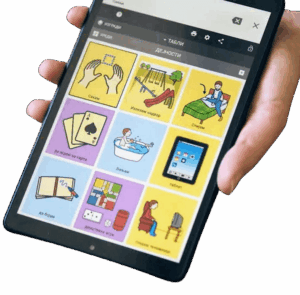
If you are interested in open source software projects for assistive tech, take a look at CBoard. It is a free/open source app for AAC (Assisted and Augemented Communication). It’s for anyone with speech and language impairments, facilitating communication with pictures and text-to-speech. You can use it to quickly construct useful communication boards, and it’s beautifully customizable. Currently, it supports 46 languages. There is a paid/subscription level to this app which makes it even more useful (and which supports the ongoing maintenance and development of the project).

a hand holding a phone or small tablet with nine colorful symbols and words used for communication

If you want to learn more about the current, complicated political, technical, and social landscape of AAC, here is a list of useful updates from Bob Williams, of the organization CommunicationFIRST:

Best Practices for Online Meetings with AAC Users

Technology for Equitable Communication: AAC Users Weigh In

New Film, 13 AAC Users: Priorities for Future Research

The FCC Needs to Address Digital Discrimination Against People Who Need AAC | CommunicationFIRST

CommunicationFIRST Petitions FCC to Add Text and Video Options for Suicide Lifeline | CommunicationFIRST

The FCC Needs to Address Digital Discrimination Against People Who Need AAC | CommunicationFIRST

2023-10-03 C1st Comments to DOJ on Title II Web Access Proposed Rule

Unjustly isolated, silenced, and deprived of literacy and freedom of expression … | CommunicationFIRST

Leave a Comment