Press "Enter" to skip to content

Category: wheelchairs

Toddler mobility trainer build report

UC Berkeley has a little report on the recent Toddler Mobility Trainer build party at the engineering lab where GOAT (me and Emma, in this case!) showed up to volunteer and observe, alongside Make Good West lead Dana Yichye Shwachman. Dana had prepared all the parts and materials and instructions necessary to make four of the plywood TMTs.
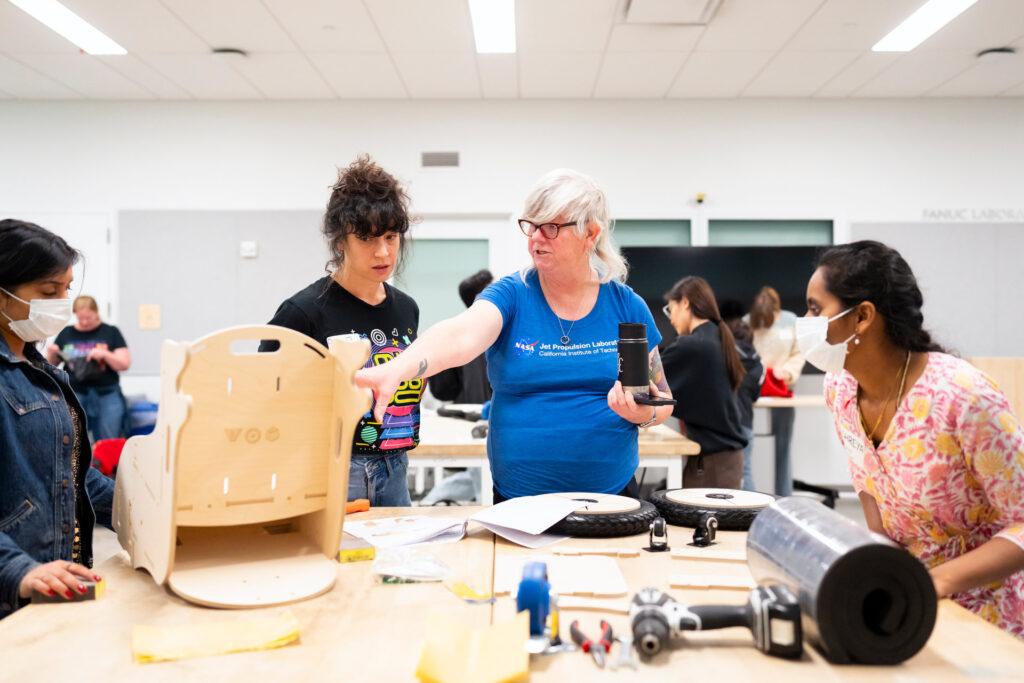
several people gathered around a wheelchair being built on a large workbench

These plywood based designs are from TOM, Tikkun Olam Makers and come in two sizes. I believe Dana had a large hand in making that design happen. A year or two ago, Make Good basically took their designs and modified them to create their own 3-D printed Toddler Mobility Trainer. That project from Make Good was partly funded by the fund that I do program work for, DIFxTech, via my contract work for Borealis Philanthropy. So I was there for GOAT, because we want to try making our own TMT and hosting a build party led by wheelchair users — but I was kind of also there with my “funder” hat on to see what they are up to, in person!
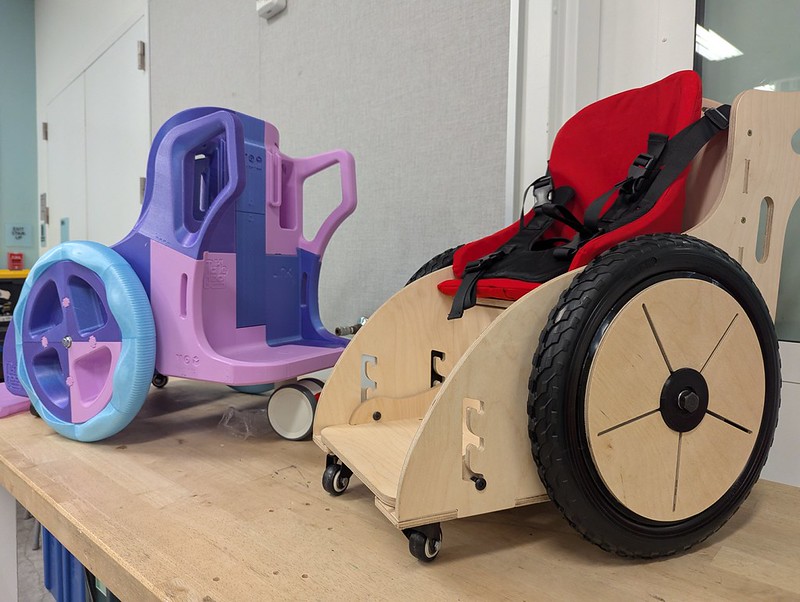
3d printed and plywood home built tiny wheelchairs

Four teams of student volunteers were there walking through the instructions, sanding, assembling, and testing their TMTs. They also came with seatbelt harnesses and cloth and foam cushions (sewn by Dana!). Emma, who does makerspace maintenance work and who is a natural mentor and teacher, was floating between teams, lending a hand & giving advice to the student volunteers, while I was chatting with Dana and then got to spend some time with a mom and her young child who showed up to take a free TMT home. Dana’s energy and enthusiasm are so infectious, it was really wonderful and fun to participate in her event!

I noticed that for many of the students it was their first time using tools and power tools, or maybe first beyond maybe assembling IKEA furniture. I think they were having a great learning experience! In general, I think that it is helpful in these events to have a few more helpers who know their way around tools and a makerspace or shop. And ideally there would also be a gofer to run to the hardware store when that is needed (as it so often is for any project!)

I had the feeling that being there as an adult wheelchair user, with tools in my hand, was an important political act. My simply being there disrupted the narrative. You know the story. A helpless disabled child is being given something by able bodied people in an act of charity. Was that the story? I don’t think so. It is a story of mutual aid and interdependence.

It was equally educational for the Berkeley student volunteers to see a wheelchair user who was not a child, who was talking to them, who has a deep grounding in disability justice and disability rights. We are not simply passive consumers or recipients. I do not believe in the idea of being “a voice for the voiceless”. Everyone has a voice, a perspective, and agency and we can listen to them whether they are speaking or not, and no matter how old they are.

Disrupting that “charity/ pity” narrative is a critical part of GOAT’s work!!

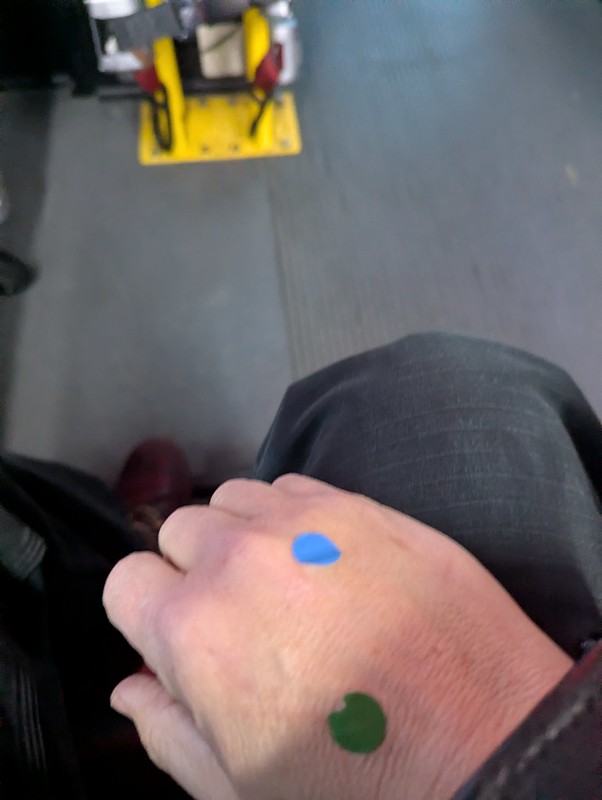
Anyway, I had fun hanging out with Charlotte and her mom. I like to give stickers to kids but I had forgotten my usual sticker pack! Dana gave me some little dot stickers, and I told Charlotte about the book “Put Me in the Zoo” about a sort of magical leopard who has rainbow spots and can put his spots onto things and people and play with them. Then we put dots on each other and on our chairs. Emma and I also talked with her mom about some ways that the new chair could be modified to be more comfortable and appropriate for Charlotte. For example the side of the chair, while sanded well, did not seem to be to be pleasant to rest one’s hand or arm on. Physical comfort and joy are very important to disabled experience!

book cover of put me in the zoo with a cartoon leopard with rainbow spots

colorful dot stickers on liz's hand

There could also be a little cushioned guide for Charlotte to rest her arm in so that she can more easily keep it in wheel rim pushing position. I think that the plywood hubs of the wheels could easily be enhanced with bumps for push rim grips and in fact it would be fun to design a 3-D printed option which would be lighter than the plywood hubs. Follow up like this might be a good place for a partnership between Make Good West, GOAT, and local orgs like C4AT and Through the Looking Glass. We’ll see if we can make that happen!
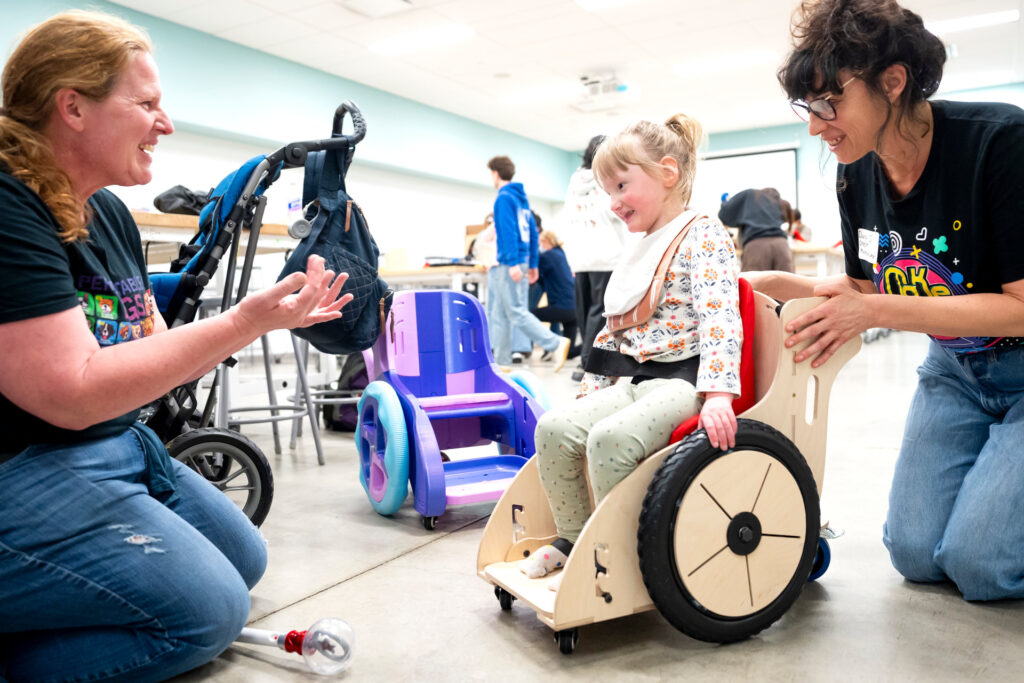
kid and mom smiling while dana adjusts part of the plywood wheelchair

I will add that the Berkeley article left out a critical piece of this work. The reason we need TMTs is not because no one makes a small wheelchair. That is bunk. Or at least it is not the main reason. It is that pediatric wheelchairs are hellaciously expensive. If they are classified as medical devices (DME, Durable Medical Equipment) then good luck making them affordable or available. That is part of why everyone is carefully saying TMT rather than “Wheelchair”.

This may be particular to the U.S., but young children with mobility difficulties can’t qualify via Medicare or their private insurance for a wheelchair until they can prove that they know how to use it. So a child who is at exactly the right age developmentally for learning how to move their body around the world is left unable to explore. How are they supposed to prove their capability without having equipment, time, and space to play and learn?

Charlotte was also denied a wheelchair by her medical coverage, specifically because of her visual impairment. This made my blood absolutely boil.

Simply giving someone a piece of technology is never enough. I know that Charlotte’s family is able to connect her with occupational therapy and she is in a supportive school so I am not too worried in her case. But in general I have to add this cautionary note that follow up and continued contact is key. Even for this “toy” wheelchair we can note what works for a person and what doesn’t.

Of course, I would also say we can give tools for maintenance and options for customizing, to anyone getting a TMT!

Leave a Comment
Tune Up Tuesday at the DCC

Our March Tune Up was at the Disability Cultural Center in SF. Now that we have a regular monthly cadence for these events, I printed and distributed flyers to pass out on the street.

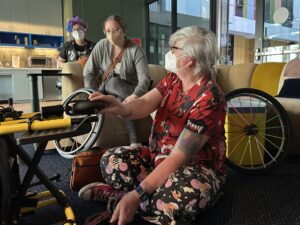
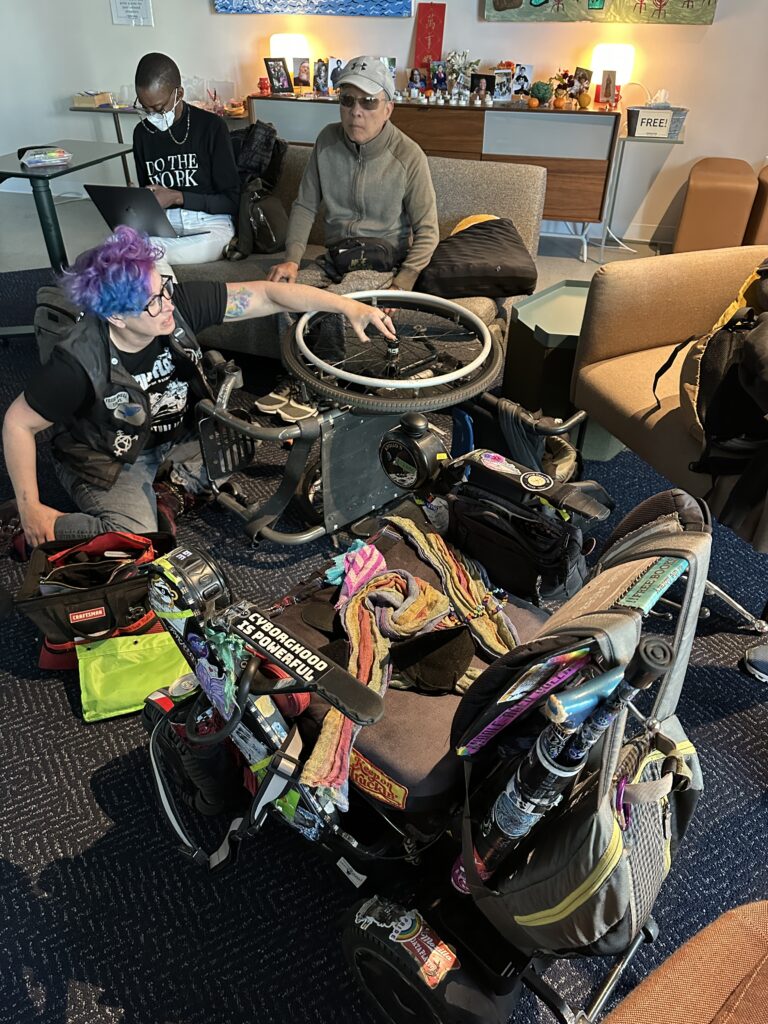
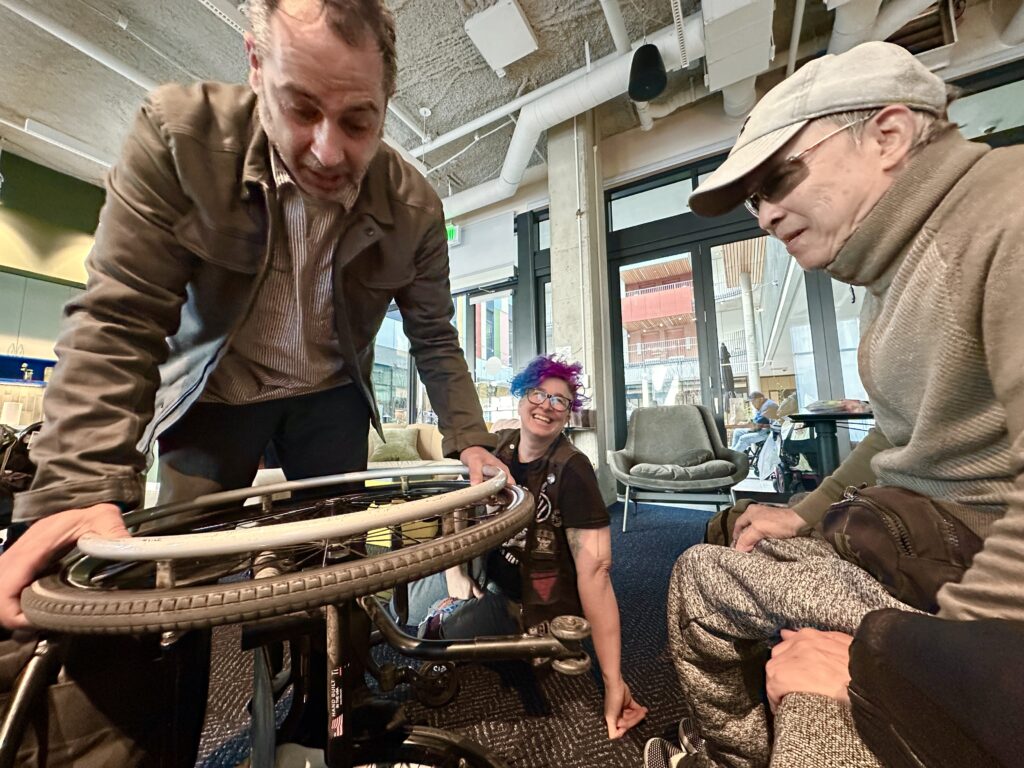
overhead shot of liz on the floor with the manual chair and its stuck wheel, empty powerchair in foreground

I learned some things from my stroll down Mission from 24th Street BART station to 16th, talking with every wheelchair user I met along the way. Everyone needs maintenance on their chairs. Everyone’s front casters are shot. They rarely have their own tools. I found that if I exchanged contact info with people i talked with, then remind them about the Tune Up event, they are more likely to show up. When people got their equipment from donations, they are not likely to know where to go for maintenance.

On the day of the event I also canvassed Civic Center and UN Plazas. The result of that was several guys in powerchairs following me back to the DCC and one arriving a bit later. I had the feeling like we were a powerful brigade of little tanks rolling together in the sunny and beautiful day!

We ended up with 12 participants, I passed out toolkits to 11 of them, and we spent the next three hours hanging out, chatting, having snacks, and trying to either fix issues, experiment with modifications, or make lists of deeper problems to address. Vince from ILRCSF, our actually experienced wheelchair tech, was great help and followed up with several people the next day for replacement front casters, new (donated) batteries, and other things. We all get to listen in as he calls vendors and manufacturers for information, learning from his approach. C. from last month’s Tune Up showed up — with her front casters replaced thanks to Vince!

A lot of hair and gunk was removed from wheels, all around!!!! I think we need an entire session for Hairball Day and compete to see who can collect the most disgusting combo of greasy, dirty, pet and human hair.

A side function of Hairball Day is that everyone learns the parts of the chair. Axle, caster, and most importantly… bearings. I now kind of compulsively nag total strangers to protect their bearings and to replace the end caps that should protect those bearings from water and grit.

One person who came with a very nice Ti Lite manual chair ended up with 4 of us on the floor trying to remove one of his quick release wheels. It was NOT quick and it was not releasing! The next move really would have been to bang it lightly with an actual sledgehammer, which we weren’t prepared for, and neither was the chair’s rider! This turned out to be his old chair. He has an “identical” new one but likes the old one better. Maybe this sounds funny to you, but I do the same thing. It feels just slightly wrong to use the new one when the old one still works and it’s more familiar. But in this case the solution really was, Please use your new chair, and bring the old one in to have a little spa day with the sledgehammer so that the quick release wheel (and maybe the entire axle assembly) can get replaced.

Vince Lopez bending over a stuck wheel with its owner bending over to see the problem, liz laughing a bit in background

I adjusted the brakes and other bits of someone’s tall rollator, and Emma from GOAT and volunteers from Streets Forward helped to adjust the center of gravity (CoG) of another manual chair.

woman wearing a mask with tools working on a manual wheelchair with its rider consulting

My flyers promised cup holders, but I forgot to bring them!

I need to organize a much better, and smaller, tool bag for myself to bring to events. I am eyeing the kind that open up and show everything neatly stashed away. It would be nice not to have my tools “explode” over all the surface area of our work space!

Community strength was coming through in our event. We had some quality snacks and free coffee and tea thanks to the DCC. (Maybe I’ll come through and make cookies next time!!!) We were loafing on the couches, hanging out in the pleasant patio among the plants, charging up our powerchairs and phones.

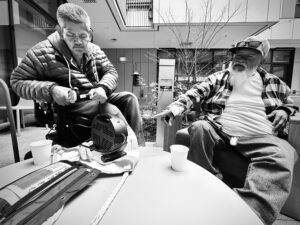
two men, friends from the plaza, sit on the patio recharging their powerchairs and phones

For many years I have noted that when I talk with a wheelchair user about maintenance and repair, it is very likely to elicit difficult stories. My own nightmares are often about my wheelchair going missing or breaking underneath me. The stories people tell of stress, fear, pain, frustration, loss of independence, loss of their own health as well as mobility, from their chairs breaking, are of deep trauma.

With that in mind, what we are doing is healing for us as people, we are healing our own relationship with our tech and making something scary and bad turn to, I can even use the words joy or celebration. We did not fix every problem that afternoon. But we paid attention, listened, took notes, and got the ball rolling. We took something that feels like an unpleasant and risky chore that is disempowering, and made it a little party that helped us all feel agency and power and friendship.

I hope everyone will come back! Our next event is April 7 at the DCC.

That kind of community and solidarity is what we want to build!!!

Leave a Comment

Tune Up Tuesdays: Feb. 17th at ILRCSF

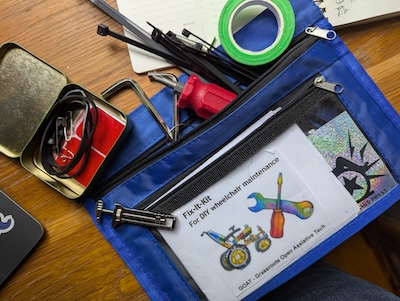
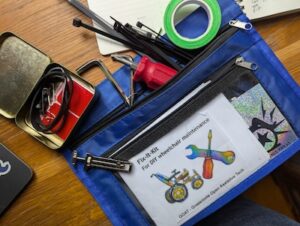
a colorful zine and some tools coming out of a zippered pencil pouchGOAT is now co-hosting monthly wheelchair maintenance workshops along with Vince Lopez from ILRCSF!
Our first Tune Up Tuesday will be held at the ILRCSF office.

When: Tuesday, Feb. 17, 2:30pm – 4:30pm
Where: ILRCSF, 825 Howard St, San Francisco
Register: Contact Vince, 415-609-2555 or vincent@ilrcsf.org

We can inspect your mobility device together, talk about anything about your chair that is causing you trouble, do some basic maintenance, teach you preventative maintenance, and share free tools and materials.

Users of manual wheelchairs, powerchair, scooter, rollators, and other mobility equipment, and their friends and family, are welcome to drop by!

We can also help you to find the service manual and user manual for your own device, and get it to you in a paper or an electronic copy.

GOAT has free mini-toolkits to give out along with a short guide on San Francisco repair, DIY, and assistive tech resources!

A longer guide covering wheelchair repair in the larger San Francisco Bay Area is updated regularly by the Center for Independent Living’s tech staff.

We also often have free accessories like cargo nets, headlights, bags or pouches, and so on. And we’re happy to work with you to improve what you have now, so that it meets your needs.

Finally, if you are interested in learning wheelchair maintenance and repair, either to support yourself and friends, or as a possible career, come by and help out as a volunteer!

Our March Tune up Tuesday will be hosted at the Disability Cultural Center. We plan to host it there regularly!

Leave a Comment

Adaptations on the street

I’m always fascinated by talking with other wheelchair users about the ways they customize and add attachments to their devices. Usually that means a lot of clips, bags, backpacks, pouches, velcro, cable ties, and so on. People develop a whole system of what to store where, depending on how they use their chair and how far to the side or back they can reach.

The other day on the bus I was chatting with the guy in the wheelchair spot across from me. I’ll call him “Kez” for anonymity! His chair was a very beat up, basic “hospital chair”, a heavy folding x-frame chair with a sling seat. He was super friendly and nice so I had to ask him why he had thin twine strung back and forth under his seat. It was quite thin and breakable looking, and a bit chaotically strung, like a net or web woven without much concept of creating a regular pattern. He explained that even though the string – almost thread! was so thin, it was still useful for carrying groceries or blankets under the seat. I offered to find him a bungee cord or two but he said no. Apparently a shelter where he stays doesn’t allow thicker string or rope or bungies, because it is considered a suicide risk.

Honestly this shocked me a bit! I am very curious to talk with him again and find out more details. I also want to talk with some shelter staff and find out more about their policies. If I could learn their rules then maybe I can think of some improvements that people like Kez can use. And I’m talking with other folks like C.R.I.P.S.R.I.S.E. about doing a sort of rolling survey, a bit more formalized, to find out what assistive tech help people in Kez’s situation might find useful. We can’t solve every problem a person on the street faces, but we could get a better idea of how to merge their DIY techniques with our expertise and resources to be of more practical help.

People with insurance and doctors have one set of problems in getting and maintaining their mobility gear; people dealing with Medicare have extra layers to that. Unfortunately, for everyone on the street in my city I’ve talked with there are orders of magnitude more problems. Literally “hacks” like tying one’s manual chair to one’s leg with rope so it is less likely to be stolen in the night.

A depressing reality. But it’s testimony to people’s creativity and DIY ingenuity to help themselves and their friends to survive.

Our second batch of “Fix It Kits” are in the works; a similar tool bag with small tools and supplies, but this version will be new: the Street Kit, to support people in precarious situations. It will include a local resources guide, a couple of useful tools, and more “on the fly” supplies like cable ties and velcro straps for quick modifications and emergency repair.

I have a version of this kit (with an added cargo net that I hope will pass muster as “safe” at shelters) that I’m carrying with me daily in case I run into Kez again on the street or on the bus!

My hope is that when they are distributed (by me or by others, maybe by local services organizations) I can collect some contact information and wishes/needs for other repairs or modifications. Stay tuned for more on the Street Kits!!

Leave a Comment

Love Your Ride – wheelchair maintenance and repair workshop

GOAT is running another free workshop in San Francisco, at the Independent Living
Resource Center SF! In honor of Valentine’s Day we are calling it “Love Your Ride”. At this event we will test out our pilot Fix-It-Kits, which are small pouches of tools and materials, along with a pocket sized zine.

The zine has a workbook page to record useful information about your mobility device, and then goes through inspection, cleaning, checking vulnerable points like all bolts, screws, wheels, folding parts, and attachments. Collecting that info will help us construct a custom kit, with replacement bolts, tools for tightening bolts and screws, and so on.

a colorful zine and some tools coming out of a zippered pencil pouch

Free workshop to learn maintenance for your mobility gear
Wheelchairs, powerchairs, scooters, walkers, rollators, etc.

Time: Saturday, Feb. 22, 2:00pm – 4:00pm
Location: ILRCSF, 825 Howard Street – San Francisco

FREE TOOLKIT AND INSTRUCTION MANUAL

We will work with you to make a custom maintenance and emergency repair kit!
You will get to take home a small, portable bag with tools and materials customized for you.

There is also a workbook to fill out with information about your mobility device or devices.

We will look for service manuals and other information to give you as well!

Please register by emailing Brianna@ilrcsf.org with your name, phone number, and any particular access needs you have. Or you can call or text Vincent @ 415-609-2555 if you prefer that to email. We’d love to see you there!

A joint workshop by Grassroots Open Assistive Tech and ILRCSF
Liz Henry, liz@openassistivetech.org, https://openassistivetech.org
Vincent Lopez, vincent@ilrcsf.org, https://ilrcsf.org
Marisol Ferrante, marisol@ilrcsf.org, Nick Feldman Assistive Tech Lending Library

Leave a Comment