UC Berkeley has a little report on the recent Toddler Mobility Trainer build party at the engineering lab where GOAT (me and Emma, in this case!) showed up to volunteer and observe, alongside Make Good West lead Dana Yichye Shwachman. Dana had prepared all the parts and materials and instructions necessary to make four of the plywood TMTs.
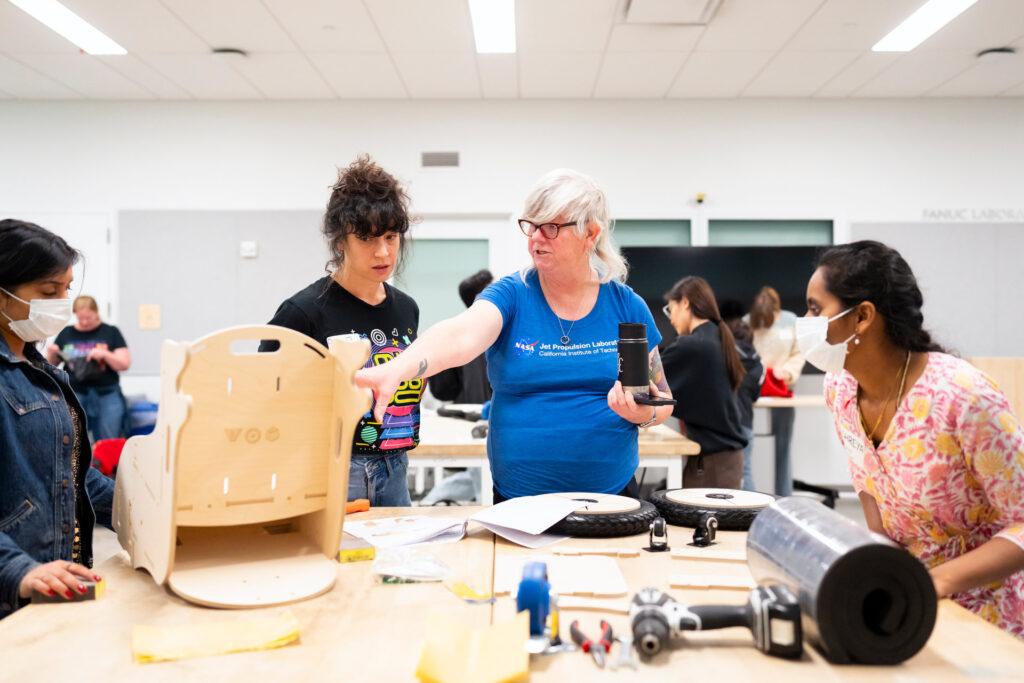
These plywood based designs are from TOM, Tikkun Olam Makers and come in two sizes. I believe Dana had a large hand in making that design happen. A year or two ago, Make Good basically took their designs and modified them to create their own 3-D printed Toddler Mobility Trainer. That project from Make Good was partly funded by the fund that I do program work for, DIFxTech, via my contract work for Borealis Philanthropy. So I was there for GOAT, because we want to try making our own TMT and hosting a build party led by wheelchair users — but I was kind of also there with my “funder” hat on to see what they are up to, in person!
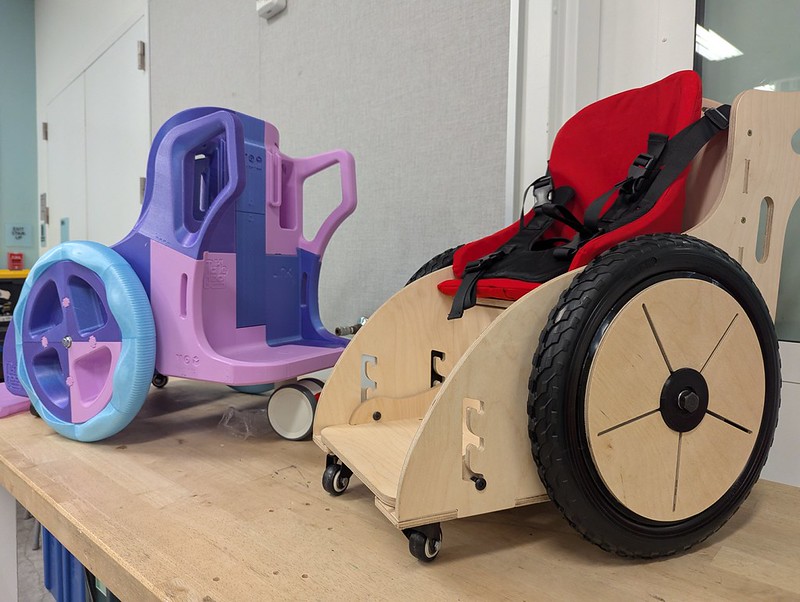
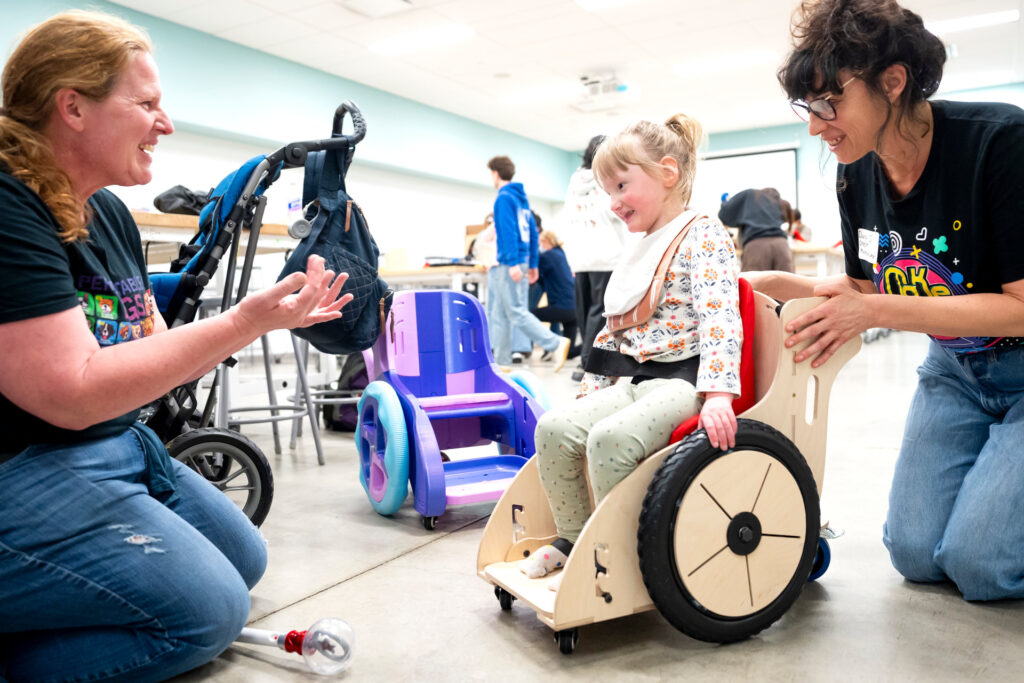
Four teams of student volunteers were there walking through the instructions, sanding, assembling, and testing their TMTs. They also came with seatbelt harnesses and cloth and foam cushions (sewn by Dana!). Emma, who does makerspace maintenance work and who is a natural mentor and teacher, was floating between teams, lending a hand & giving advice to the student volunteers, while I was chatting with Dana and then got to spend some time with a mom and her young child who showed up to take a free TMT home. Dana’s energy and enthusiasm are so infectious, it was really wonderful and fun to participate in her event!
I noticed that for many of the students it was their first time using tools and power tools, or maybe first beyond maybe assembling IKEA furniture. I think they were having a great learning experience! In general, I think that it is helpful in these events to have a few more helpers who know their way around tools and a makerspace or shop. And ideally there would also be a gofer to run to the hardware store when that is needed (as it so often is for any project!)
I had the feeling that being there as an adult wheelchair user, with tools in my hand, was an important political act. My simply being there disrupted the narrative. You know the story. A helpless disabled child is being given something by able bodied people in an act of charity. Was that the story? I don’t think so. It is a story of mutual aid and interdependence.
It was equally educational for the Berkeley student volunteers to see a wheelchair user who was not a child, who was talking to them, who has a deep grounding in disability justice and disability rights. We are not simply passive consumers or recipients. I do not believe in the idea of being “a voice for the voiceless”. Everyone has a voice, a perspective, and agency and we can listen to them whether they are speaking or not, and no matter how old they are.
Disrupting that “charity/ pity” narrative is a critical part of GOAT’s work!!
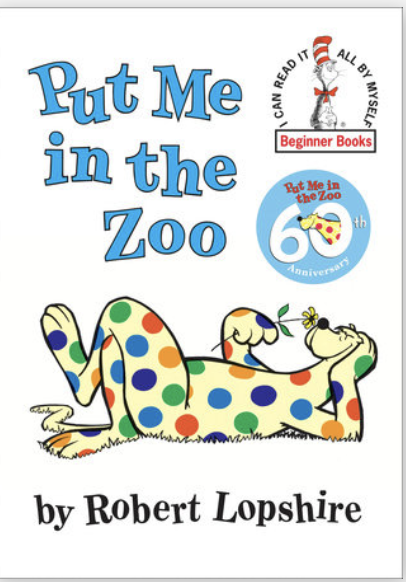
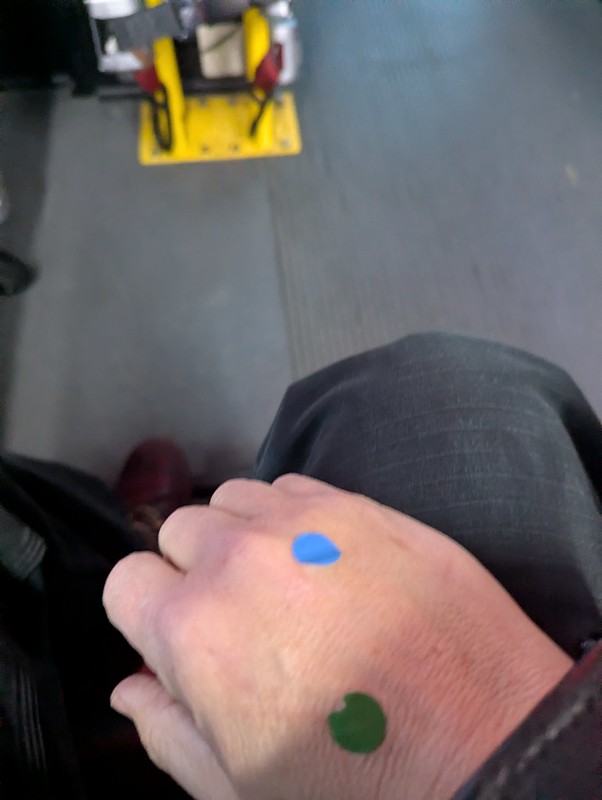
Anyway, I had fun hanging out with Charlotte and her mom. I like to give stickers to kids but I had forgotten my usual sticker pack! Dana gave me some little dot stickers, and I told Charlotte about the book “Put Me in the Zoo” about a sort of magical leopard who has rainbow spots and can put his spots onto things and people and play with them. Then we put dots on each other and on our chairs. Emma and I also talked with her mom about some ways that the new chair could be modified to be more comfortable and appropriate for Charlotte. For example the side of the chair, while sanded well, did not seem to be to be pleasant to rest one’s hand or arm on. Physical comfort and joy are very important to disabled experience!
There could also be a little cushioned guide for Charlotte to rest her arm in so that she can more easily keep it in wheel rim pushing position. I think that the plywood hubs of the wheels could easily be enhanced with bumps for push rim grips and in fact it would be fun to design a 3-D printed option which would be lighter than the plywood hubs. Follow up like this might be a good place for a partnership between Make Good West, GOAT, and local orgs like C4AT and Through the Looking Glass. We’ll see if we can make that happen!
I will add that the Berkeley article left out a critical piece of this work. The reason we need TMTs is not because no one makes a small wheelchair. That is bunk. Or at least it is not the main reason. It is that pediatric wheelchairs are hellaciously expensive. If they are classified as medical devices (DME, Durable Medical Equipment) then good luck making them affordable or available. That is part of why everyone is carefully saying TMT rather than “Wheelchair”.
This may be particular to the U.S., but young children with mobility difficulties can’t qualify via Medicare or their private insurance for a wheelchair until they can prove that they know how to use it. So a child who is at exactly the right age developmentally for learning how to move their body around the world is left unable to explore. How are they supposed to prove their capability without having equipment, time, and space to play and learn?
Charlotte was also denied a wheelchair by her medical coverage, specifically because of her visual impairment. This made my blood absolutely boil.
Simply giving someone a piece of technology is never enough. I know that Charlotte’s family is able to connect her with occupational therapy and she is in a supportive school so I am not too worried in her case. But in general I have to add this cautionary note that follow up and continued contact is key. Even for this “toy” wheelchair we can note what works for a person and what doesn’t.
Of course, I would also say we can give tools for maintenance and options for customizing, to anyone getting a TMT!