Last fall, GOAT started collaborating with Andrei, a wheelchair user in Moldova, to help out with his Permobil F5 joystick issues. Here’s an update! We have ended up in a more long term collaboration between Easy Does It Services, ILRCSF, occupational therapist Judi Rogers, and the CIL in Berkeley to get the necessary equipment and expertise so he can get outside this spring. It has been really delightful getting to know Andrei and working with everyone!
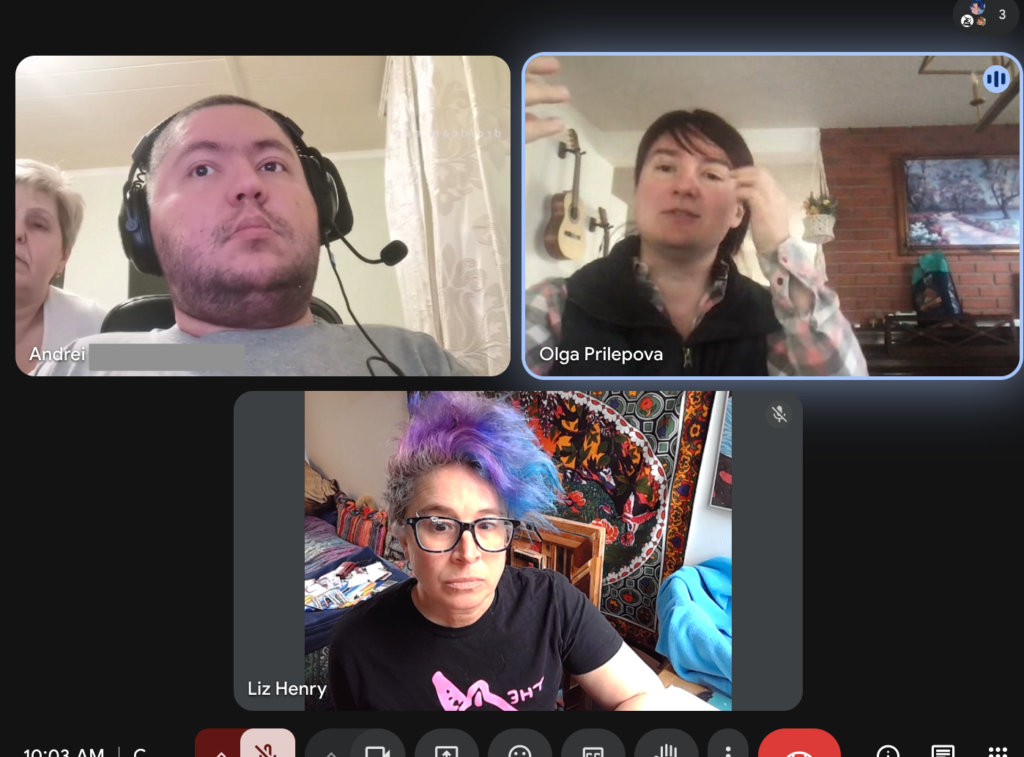
While Andrei’s fluency in English is great, we end up with our meetings half in Russian and half in English since Levan and Olga both also speak Russian. I turn on Google Translate in my phone to get near-instant written translation of the meeting. I have even learned a few Russian words though they are the bare minimum of what you might absorb easily: Yes, No, OK (horosho) and Thanks!
Levan from EDI and Olga are doing a ton of work to provide Andrei with several different options to control his powerchair and also to give him some flexible options for game and computer control that are less dependent on hand strength and dexterity. This includes chin, head, and attendant controls as well as a mini joystick and new armrest/table, new batteries, more positioning / seating options, and all the stuff to mount these things onto the chair. Some of that is from scavenged or donated supplies and some is new (funded by YOU!)
Andrei already experiments with his computer control setup a lot, so I am always learning about new software from him. For example, he recommends Handy as free and open source software for speech to text. As a bonus it is very privacy protecting (and fast) as it doesn’t send your voice or text to the cloud, it works locally on your devices and is highly customizable. He also talked a bit about VoiceBot, which sounds interesting, but is less free. And this device called a Razer Tartarus, extremely cool visually, which used to work well for him, but which now he needs to adapt in some way so that he can control it.
Bruce is always sending new ideas and contacting manufactorers for potential devices, like mouth control via the MouthPad , and others have stepped in to suggest drug therapies that can slow the progression of Andrei’s condition, something that will become possible if either Genentech opens a deal for compassionate therapy with his country, or if his dual citizenship with his father’s country comes through.
We have planned out Olga’s visit to Moldova, but have not yet pinned down a travel date. It should be pretty close, though. We are thinking if not before, then maybe in March just after we get back from the CSUN Assistive Technology conference.
Thank you for all your donations that are making this collaboration possible!
The point that comes through very strongly in this project ,as well as even our most casual workshop, is that THE TECHNOLOGY IS NOT ENOUGH. You can have the fanciest, most expensive assistive tech in the world, and it means nothing if you don’t have expert help or advice in making it work for you — the role of occupational or rehab therapists. AND, you need resources for maintenance, repair, spare parts, service manuals, and help to implement all of this, which is also something that can’t be done in one half hour encounter, you need to try things, iterate, and adjust in collaboration.
We all need a “pit crew” to keep us rolling!