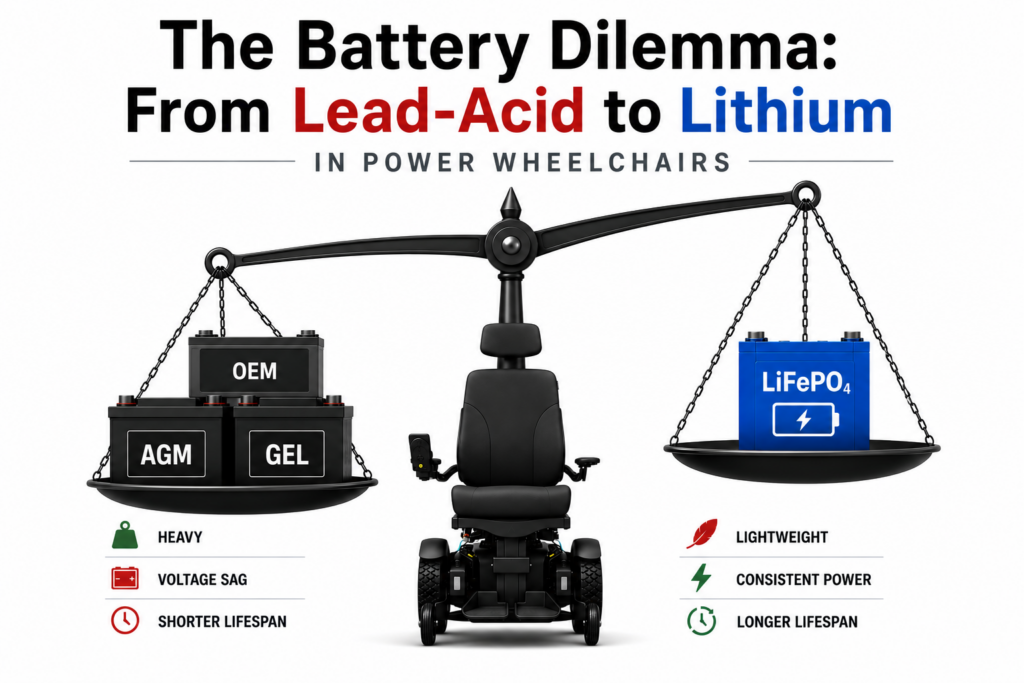
Choosing the right battery fundamentally changes the experience of using a power wheelchair. As the grassroots assistive tech community pushes for the Right to Repair and hardware independence, the shift from traditional lead-acid to custom lithium builds has become a topic of great interest. Most power wheelchairs operate on 24V systems, typically using two 12V batteries connected in series.
Why I Started Researching LiFePO4 Batteries
Last August I bought a used Permobil F5. The original lead-acid batteries were in very poor condition — they could barely move the chair for a few meters inside the house. Around the same time, several people I know had already switched to lithium. One of them had been running LiFePO4 for over four years, while another had installed it just a few months earlier. Both kept telling me the same thing: with a proper lithium setup, you can often charge the battery only once a week, or even once every two weeks, if you mostly use the chair indoors.
This information really motivated me. I started researching whether it was possible to install a LiFePO4 battery in a Permobil F5. It turned out that quite a few people had already done this conversion successfully. I even spoke on a forum with someone from the United Kingdom who had built his own lithium pack for the same model. He described the dramatically increased range he now gets on a single charge. He also powers his non-invasive ventilator directly from the same battery. In his build he used eight EVE 160Ah cells — this specific size was chosen because the battery compartment in the Permobil F5 has very limited height, so larger cells simply wouldn’t fit.
Most LiFePO4 users I’ve spoken with feel the same way — they believe lithium is the future. They all say that the downsides are more than offset by the freedom it provides. Being able to travel 25–35 miles on a single charge without having to charge the chair every day, and without constantly worrying about damaging the battery, makes a real difference in everyday life.
To better understand why lithium makes such a big difference compared to traditional batteries, let’s first look at the main battery types used in power wheelchairs today.
Common Battery Sizes and Typical Range in Power Wheelchairs
Most power wheelchairs use two 12V batteries connected in series to create a 24V system. Batteries come in several standard physical sizes (called “group sizes”). The most common ones are:
- U1 (Group 22NF): Usually 30–55 Ah. Common in lighter and more portable wheelchairs.
- Group 24: Typically 60–85 Ah. One of the most widely used sizes for standard adult power wheelchairs.
- Group 27: Often 80–110 Ah. Used in heavier-duty and bariatric chairs.
- Group 34: Less common, but found in some larger models.
Important note on usable capacity: With traditional AGM and GEL batteries, it is generally not recommended to discharge them below 50% if you want to maintain a reasonable lifespan. This means that from a 74Ah AGM or GEL battery you can realistically use only about 35–37Ah. LiFePO4 batteries can safely deliver 80–100% of their rated capacity, so a 74Ah LiFePO4 pack can provide roughly 60–74Ah of usable energy.
Real-world range depends on the user’s weight, terrain, speed, temperature, and driving style. As a general guideline:
- Good quality AGM or GEL batteries usually deliver 10–18 miles (16–29 km) of range.
- Well-built custom LiFePO4 packs typically achieve 18–32 miles (29–51 km) in real conditions, with some users reaching 35–40 miles under ideal circumstances.
Comparing the Main Battery Types
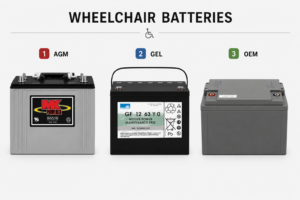
AGM (Absorbent Glass Mat) Batteries
This is the most common type. The electrolyte is absorbed in fiberglass mats. Popular examples include MK Battery in U1 and Group 24 sizes.
Pros: Good burst power, relatively low cost, provides natural ballast for stability.
Cons: Significant voltage sag when discharging, short lifespan (1–1.5 years), sensitive to deep discharge.
GEL Batteries
Similar to AGM but with the electrolyte in silica gel. Often positioned as a premium lead-acid option (examples: MK Battery GEL, Sonnenschein).
Pros: Better cycle life than AGM, slightly more tolerant to deep discharge.
Cons: Very sensitive to charging voltage, poor cold weather performance, higher price.
OEM (Factory Branded) Batteries
Batteries sold by wheelchair manufacturers (Permobil, Pride Mobility, Invacare etc.). In most cases these are rebranded AGM or GEL batteries.
Pros: Perfect physical fit, usually maintains warranty.
Cons: Significantly more expensive (“brand tax”), sometimes include software locks (DRM).

The Lithium Upgrade (LiFePO4)
Lithium Iron Phosphate (LiFePO4 or LFP) is one of the safest and most practical lithium battery chemistries available today. Unlike conventional lithium-ion batteries (such as NMC or NCA), LiFePO4 uses iron phosphate as the cathode material. This makes it significantly more thermally stable and much less prone to thermal runaway (fire or explosion) even if the battery is damaged, overcharged, or short-circuited.
Because of its safety characteristics and long cycle life, LiFePO4 has become the preferred chemistry for custom power wheelchair builds and is increasingly being offered as a factory option by some manufacturers (for example, Ottobock on the Juvo series and Pride Mobility on the Jazzy EVO 613Li).
What is a BMS?
BMS stands for Battery Management System. It is the electronic “brain” of a lithium battery. It constantly monitors voltage, temperature and current, protects the battery from overcharging, deep discharging, overheating and short circuits, and balances the individual cells so they work evenly. A good BMS is essential — without it a lithium battery can be damaged or become unsafe.
How a LiFePO4 battery is built
A typical 24V LiFePO4 battery for a power wheelchair consists of 8 prismatic cells connected in series (each cell has a nominal voltage of 3.2V). High-quality cells from manufacturers such as EVE or CATL are most commonly used. These cells are connected to a BMS, thick power cables, appropriate fuses or circuit breakers, and are securely mounted in the battery compartment.
Pros:
- Comparable upfront cost with much better long-term economics: A quality LiFePO4 build with a good BMS usually costs about the same as a pair of premium GEL batteries, but lasts significantly longer (often 5–10 years).
- Radical weight reduction: A well-built 24V LiFePO4 pack typically weighs 25–35 lbs (12–16 kg) instead of ~100 lbs (45 kg) for a lead-acid pair.
- Flat power curve: The wheelchair maintains strong and consistent performance even at lower states of charge — there is almost no voltage sag.
- Much higher usable capacity: You can safely use 80–100% of the rated capacity, compared to only ~50% with AGM/GEL batteries.
Cons:
- Requires proper assembly: Needs correct calculations, heavy-gauge wiring, quality circuit breakers (100A+), proper fusing and good insulation.
- Dedicated charger required: Standard lead-acid chargers will damage the BMS and cells. A lithium-specific charger is mandatory.
- No gradual warning: Because there is almost no voltage sag, you get very little advance notice before the BMS cuts power.
- Air travel restrictions: Lithium batteries are subject to strict IATA and airline regulations. Many carriers require advance notice, battery removal or special packaging.
The Problem with Off-the-Shelf Lithium Batteries
Buying cheap ready-made 12V LiFePO4 batteries (sold for RVs or solar, such as generic “100Ah RV batteries”) is a common mistake. Most budget batteries have weak BMS boards (often limited to 30–50A continuous discharge). Power wheelchair motors create very high current spikes on startup. A weak BMS interprets these spikes as a short circuit and instantly cuts power — leaving you stranded.
Commercially available batteries with sufficiently strong BMS boards are very expensive and often too large for standard wheelchair trays. For most users, a properly engineered custom build remains the only practical solution.
Important Safety and Usage Notes for LiFePO4 Builds
- Check your current draw: Before choosing a BMS, determine the continuous and peak current consumption of your wheelchair’s motor controller. Many controllers can briefly pull 80–150A or more during acceleration and hill climbing. Select a BMS and circuit breakers with adequate headroom.
- Discharge limit: Never discharge below 20–25% remaining capacity. Always keep a safety buffer — the BMS will cut power abruptly with no gradual slowdown.
- Quality BMS: Use a BMS with over-current, short-circuit, temperature and cell-balancing protection.
- Fusing: Always install appropriate circuit breakers or fuses (100A+ class recommended).
- Secure mounting: The battery must be firmly fixed — wheelchairs experience significant vibration.
- Professional help if needed: Improper assembly can damage the motor controller or create a fire hazard. If you lack experience with high-current DC systems, work with a knowledgeable technician.
The Hidden Trap of Losing Weight: Center of Gravity and Traction
One of the biggest advantages of a custom LiFePO4 build is the dramatic weight reduction. However, removing 60–80 lbs (27–36 kg) from the base changes the wheelchair’s physics:
- Loss of traction: Drive wheels need downward pressure. Without the original ballast the chair can spin its wheels on smooth ramps or wet surfaces.
- Higher center of gravity: This increases the risk of tipping, especially during quick acceleration or on slopes. Many users add bolt-on counterweights or adjust seat positioning to restore stability.
Conclusion: Making the Right Choice
Switching batteries is not just a component swap — it changes how your wheelchair feels and behaves.
If you want maximum simplicity and minimum hassle, high-quality AGM batteries (such as MK Battery) or premium GEL options remain the most straightforward traditional choice.
However, if you want to eliminate voltage sag, significantly reduce weight, increase range, and are willing to invest time or professional help into a proper build, a well-engineered custom LiFePO4 pack using quality cells (EVE, CATL, etc.) is usually the best long-term investment. The key is to approach the project responsibly — never compromise on BMS quality, always use proper fusing, respect the new physical dynamics of a lighter chair, and leave a safety buffer on every charge.
This article is for informational purposes only. Modifying batteries may affect warranty, safety certifications, and medical device compliance. Always consult with your wheelchair provider or a qualified technician before making any changes.