Press "Enter" to skip to content

Category: events

Be Seen! on Halloween – free workshop Oct 29th

Add lights, reflectors, reflective tape, sparkly jewels, and other glowing things to your mobility gear, for fun and safety! If you have a wheelchair, scooter, walker, rollator, cane, or even a bike or stroller, and you’d like to bling it up, come by the San Francisco Disability Cultural Center, 165 Grove St. in the afternoon on Wednesday, October 29th, 1pm – 3pm.

You can help us out a lot by registering here: https://disabilityculturalcenter.org/event/been-seen-on-halloween/

We will have LED light strips, portable battery packs, reflective tape, glow in the dark paint pens, and other supplies.

a gleaming wheel of blue and green lights with a  small battery pack attached

vince lopez in a flat cap holding a walker decorated with glowing lightstrips

Vincent Lopez from the ILRCSF will be there as well; he runs their wheelchair repair program and was co-host last year for GOAT’s Be Seen workshop. He can be available to consult for questions about repair and maintenance during the workshop as well!

If you can’t make it, and you’d like to get some of our useful lights or individual help, let us know and we can likely work something out — email to liz@openassistivetech.org.

A lady smiling proudly as she shows off her newly illuminated walker with spiral light strips attached.

Two asian american women smiling, one seated in powerchair with lights attached

Visiting the DCC:
map showing 165 grove street, at intersection of Grove and Van Ness, close to Civic Center BART or the Van Ness Muni train stop
Civic Center BART, Van Ness Muni station, or any of the many and frequent buses are a great way to get to the Civic Center area. The closest parking garage is at 360 Grove St. between Gough and Franklin.

Leave a Comment

Community DIFxTech talk on Software design for assistive tech

This isn’t part of GOAT, but it’s a close enough intersection that I’d like to use this blog to invite any readers to attend. In my work with Borealis Philanthropy as program manager for the DIFxTech fund, I’ve been hosting a series of talks with our grantees, advisors, and other experts and advocates, for ways we mash up disability justice with technological innovation. If you’d like to be added to the invite, please email me at difxtech@borealisphilanthropy.org.

Next up in our DIFxTech Community Conversation series:

Software design, AI, Privacy, and Disability
Maitreya Shah and Ariana Aboulafia

Host: Liz Henry
Tuesday, Oct 28, 2025 11:00am PDT – 12:30pm PDT

headshot of ariana in a nice suit, looking lawyerly

maitreya standing in front of a neutral background, holding a white cane

Maitreya Shah and Ariana Aboulafia, from the Center for Democracy in Technology & American Association of People with Disabilities, will talk about their organizations’ recent work on assistive technology and privacy by design. This guidebook, Inclusive Innovation: How to Incorporate Privacy into Inclusive Design for Assistive Technologies, was published in July this year for the 35th anniversary of the ADA, aims to provide startups with easy, actionable steps to incorporate privacy into their design process.

Maitreya Shah is a lawyer and researcher, a current DIFxTech grant recipient for a joint project with the Bazelon Center, with extensive experience working at the intersection of technology regulation and disability justice. He is Technology Policy Director at American Association of People with Disabilities; previously, he was a fellow at the Berkman Klein Center for Internet and Society at Harvard University.

Ariana Aboulafia is the Disability Rights in Technology Policy Lead at the Center for Democracy in Technology. An attorney with a strong background in disability rights, law, and public interest advocacy, Ariana previously served as an officer to the Journalism Department at the John S. and James L. Knight Foundation, as well as an assistant public defender in Miami-Dade County.

This talk will be recorded and shared, along with the chat and transcript. Previous DIFxTech Community Conversations are available at:
https://drive.google.com/drive/u/0/folders/1h_Zns7pdZfCGJyq6EygxbyOCrcvFc0uY

Access: ASL interpreters and Certified Deaf Interpreters will be on the call; there will be a text chat; and the session will be recorded with a transcript. If you have particular accommodations you would like to request, or any questions about accessibility, please contact difxtech@borealisphilanthropy.org.

screenshot of a zoom call gallery from a previous difxtech talk, with a dozen or so of the many attendees showing

More about DIFxTech:
* https://www.fordfoundation.org/news-and-stories/news-and-press/news/borealis-philanthropy-and-ford-foundation-launch-1-million-disability-x-tech-fund-to-advance-leadership-of-people-with-disabilities-in-tech-innovation/
* https://borealisphilanthropy.org/2024/12/09/the-disability-inclusion-fund-moves-over-4-75-million-to-disabled-led-organizations/

Leave a Comment

Report on Love Your Ride workshop

Our February workshop went well – small but fruitful! Unfortunately, I forgot to take photos, but we had a lot of fun!

People liked the maintenance kits and zines, and we all shared stories of our chairs breaking, repair techniques, watching online videos for tips and tricks, and of course, dealing with insurance and trying to source parts for older chairs.

Several new volunteers came to help out, some with bike or car mechanic skills and others just generally handy. Mostly that meant, working one on one with workshop participants to figure out if they could use particular custom tools or parts. Our volunteers (Maureen, Mike, Luis Felipe, Jake, and Olga) were also super helpful in finding service manuals online to email them to device owners!

And, Marisol showed off the Assistive Tech lending library while Vince shared his experiences as a wheelchair repair tech over the years.

One of our William had some amazing sites and resources and knowledge to give us. I’m hoping he will become a GOAT volunteer!

https://brokenwheelchairs.com, which has incredibly useful information about some of the most common powerchairs, like service manuals, sizes of attachment rails, and other great repair adjacent stuff. I am reaching out to the creator of that site to see if GOAT can be helpful to them !

White Raven Mobility, which has 3-D printed joystick and other small modifications available for sale at a fairly low cost – by a wheelchair user who is a maker and inventor!

Build My Wheelchair – A parts and battery shop, not cheap, but sometimes you can find a deal. And what they are really good for, is you can order parts through them, when manufacturers won’t sell direct to you.

MyATProgram – This is a program in several different states that functions as a lending library for assistive tech.

For our actual workshop we passed out the toolkits and zines, and then had a lot of extra tools and parts laid out across some tables for kit customization.

This was a great pilot event that helped me figure out what is workable in an hour and a half to two hours. For our next event, I will have a new version of the zine, and the workshop itself will have a bit more structure.

Rather than one two page spread to write down lots of different pieces of info about the device, I think we need to first frame what we are doing and why!

That means a quick round of simply listing
1. Things that have broken or worn out in the device in the past. NOT a long story – just a list.
2. Things that you wish you could modify about the device in the future. For example, stronger hooks for carrying things on the back of the seat, or a more accurate and informative battery level readout.
3. Who helps you, or might help you, with maintenance and DIY repairs? Who might learn with you and be supportive?

From there, I think we would be more ready to jump into gathering information about the specific device, and have some goals in mind.

We can aim our work at, becoming more prepared for the next time something breaks, or be able to prevent that breakage!

And, at following up later on the things that aren’t broken but that we want to change – like those stronger hook systems!

The other thing I found in our workshop is that, this subject is broad, deep, and powerful. We all as wheelchair users or assistive tech users have strong feelings about our relationship with our equipment. We depend on it like parts of our bodies. When stuff breaks and especially when we run into the enormous problems and limitations of insurance, Medicare, vendors who don’t respond, and so on — or even facing being without our critical devices for weeks or months — It can be a traumatic experience.

So, any wheelchair fixing workshop kind of tends towards story sharing , peer skill sharing, and I would say, a deepening of political awareness and solidarity. None of those stories are things that I want to fend off or interrupt. But, my thought is to make space for them towards the end of a workshop and follow it up with info on how to file complaints, how to use Right to Repair law, and other kinds of advocacy and activism we can use in those difficult situations!

The same thing is true to some extent of any kind of tech support. At least, with some of my old experience in IT, I felt it was so — my job was only partly “fixing computers” and was much more about listening to people, doing a kind of combination of therapy and pedagogy to try to get people to a place of empowerment rather than trauma and fear.

Meanwhile, I ahve great news I’ll talk more about soon, which is that we got some substantial donations! This means we can expand our toolkits and the range of tools we have available, and run more programs, as well as re-doing and expanding the Fix-It Zine.

Our Fix-It Zine in a more general form, version 2, will be available soon to buy or download & print free!

Leave a Comment

Love Your Ride – wheelchair maintenance and repair workshop

GOAT is running another free workshop in San Francisco, at the Independent Living
Resource Center SF! In honor of Valentine’s Day we are calling it “Love Your Ride”. At this event we will test out our pilot Fix-It-Kits, which are small pouches of tools and materials, along with a pocket sized zine.

The zine has a workbook page to record useful information about your mobility device, and then goes through inspection, cleaning, checking vulnerable points like all bolts, screws, wheels, folding parts, and attachments. Collecting that info will help us construct a custom kit, with replacement bolts, tools for tightening bolts and screws, and so on.

a colorful zine and some tools coming out of a zippered pencil pouch

Free workshop to learn maintenance for your mobility gear
Wheelchairs, powerchairs, scooters, walkers, rollators, etc.

Time: Saturday, Feb. 22, 2:00pm – 4:00pm
Location: ILRCSF, 825 Howard Street – San Francisco

FREE TOOLKIT AND INSTRUCTION MANUAL

We will work with you to make a custom maintenance and emergency repair kit!
You will get to take home a small, portable bag with tools and materials customized for you.

There is also a workbook to fill out with information about your mobility device or devices.

We will look for service manuals and other information to give you as well!

Please register by emailing Brianna@ilrcsf.org with your name, phone number, and any particular access needs you have. Or you can call or text Vincent @ 415-609-2555 if you prefer that to email. We’d love to see you there!

A joint workshop by Grassroots Open Assistive Tech and ILRCSF
Liz Henry, liz@openassistivetech.org, https://openassistivetech.org
Vincent Lopez, vincent@ilrcsf.org, https://ilrcsf.org
Marisol Ferrante, marisol@ilrcsf.org, Nick Feldman Assistive Tech Lending Library

Leave a Comment

Free Webinar: Power wheelchairs and Right-to-Repair law in California

MARK YOUR CALENDARS!
December 12
2:00-3:00 PM, Pacific Time

The CIL’s partners at the DONetwork are proud to put on this educational webinar explaining the ins and outs of the new Power Wheelchair Right to Repair law in California.

Please register here: https://tinyurl.com/DOnetworkSB1384

The DOnetwork will be producing a public education webinar for SB 1384, the “powered wheelchair right to repair” bill, sponsored by Sen. Dodd. This legislation becomes law on January 1, and it has impacts that will increase the ability for independent repair shops and individuals to access parts and equipment to make repairs on powered wheelchairs.

Here’s an overview of what will be covered:

  • What SB 1384 means for the community, and how it will be implemented in California?
  • How is right to repair working in other states?
  • What are the next steps for pushing this issue in California?
  • Invited panelists include State Senator Bill Dodd, Capitol Staff Ana Vazquez, a representative from NCART – the association for providers of power chairs and complex rehab technology, and a consumer.

    a whill model ci powerchair up on a jack with the front wheel removed

    Leave a Comment

    Be Seen on Halloween: a workshop for DIY lights and safety mods

    In a collaboration between GOAT and San Francisco’s Independent Living Resource Center, we held a pilot workshop in downtown SF last month, where we provided lights, reflectors, reflective tape, and other useful modifications for mobility gear.

    This is a photo heavy post! Here’s me smiling to welcome you to this workshop:
    white non binary person with glasses and purple hair, smiling, wearing tshirt with wheelchair user with symbolic flames trailing behind them

    We hosted at ILRCSF, where Vince Lopez runs a free wheelchair repair program. There, SF residents can get maintenance and repair done on their tech – and if you get stuck at home or on the street with a broken chair, Vince will come out, fix the chair or get you to a safe place and take the chair for repairs. You can even borrow a loaner powerchair, scooter, or manual chair. Also from ILRCSF, Marisol Ferrante joined us, to show off the Nick Feldman assistive tech lending library, another great free resource.

    Vince displaying a walker with spiral LEDs:
    Vince, smiling latino man with a flat cap, holding a lit up walker

    We laid out all the gear that we bought to try out for the event, including reflectors and headlamps made for bicycles, reflective tape, and various kinds of LED strips; mounting clamps, straps, cable ties, gaffer tape, and portable usb battery packs.

    an array of small gadgets laid out on a tablecloth

    None of this is very “high tech” but having it all there together made a great introduction to thinking about ways to modify mobility gear. When you set out to do this, you have several issues in play:

    * DURABILITY: The mods need to be very durable for heavy use, or easily replaceable.
    * PINCH POINTS: You need to be aware of how your chair, scooter, walker, etc. fold or are put into storage or, say, a car trunk, so you avoid putting any fragile components onto “pinch points”.
    * ATTACHMENT POINTS: You need to consider ways to attach things to your gear. That may mean velcro or cable ties to a metal tube frame, or some other method of attachment. Clamps meant for motorcycles, bikes, or camera tripods often work well, but every wheelchair is different, and people also have different use patterns for them.
    * POWER: If you are dealing with electronics, as we were with light strips, you need a power source. I like external battery packs, because they are easy to attach to a frame, or put into a small pouch.
    * COST: Often, cheaper is better! It can be a tradeoff between durability and cost, though.
    * DIY-ability: You may need easy do-it-yourself solutions. Ideally we would have the resources of an auto body shop, and be able to cut and weld metal, but that isn’t always realistic!

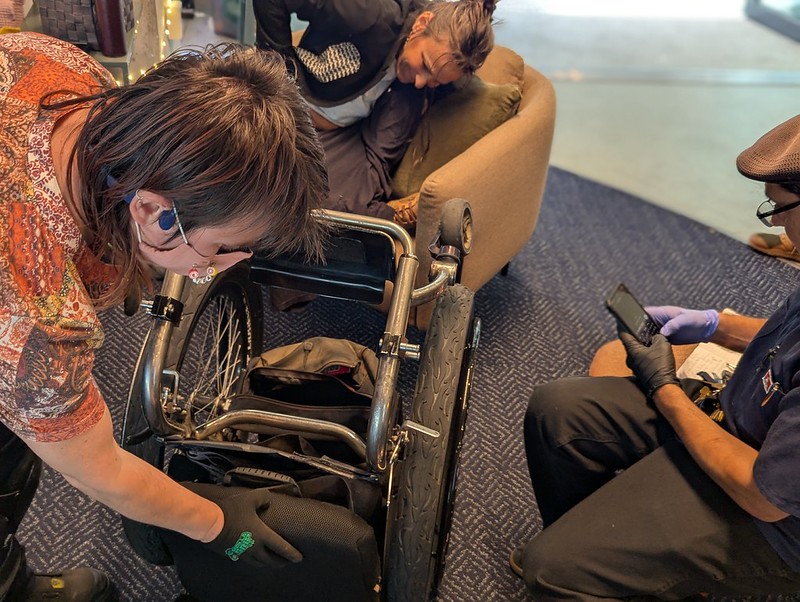
    We had a blast setting people up with gear. Everyone had a try at installing their own equipment or working with people who came with them to get lights on their walkers and wheelchairs.

    Judy worked with me and her daughter to line the bottoms of her foot rest plates with twinkly christmas-light style LEDs. The LEDs also had a remote control so she could change their color. She also asked for two headlights pointing downwards from the footplate so that it would be easier for her to see curbs or bumps in the sidewalk.

    Part of the fun of working with other wheelchair users for me is always seeing how they have come up with their own solutions. Judy’s main hack was that she had dozens of rubber bands of all sizes around her powerchair arm. She used these to keep her phone in place on the wide arm, and then set up the remote control for the lights on the other arm of the chair. I am adding the deceptively simple (and cheap!) “plain old rubber bands” solution to my tool box!

    While we installed the lights I also noticed Judy’s foam insulation tape added to the rim of her footplates. If you have been in a powerchair user’s house you may have noticed some dents in the walls! And things like protective strips along corners that stick out, because a powerchair packs a lot of force even at low speeds. The easily replaceable, cheap foam strips are a great idea to save wear and tear on your walls and other people’s shins! But, Judy’s daughter mentioned they peel off and look kind of bad as well. I suggested narrow black gaffer tape wrapped around the foam and foot plates. It isn’t perfect, it won’t last forever, but it will look nicer and will make the foam last for a year or two instead of a month. To refresh it — just add more tape! Gaffer tape is more expensive than duct tape, but is flexible and will last much longer.


    Video description: an asian american lady in a powerchair, waving, and her daughter, posing with smiles as the lights under the chair’s footrests blink and glow.

    Deniz came with a travelscoot and a walker, and her own pit crew who were very enthusiastic helpers! They went for the lights, and installed COB (chip on board) LED strips along with a cable splitter and a battery pack on each device. The Y splitter means you can symmetrically install two light strips and plug them into one centrally located battery pack. Their install job was flawless!

    A smiling woman with a halloween party hat, sitting on a travelscoot, with two guys doing thumbs up behind her

    Bill tried out some lights of various kinds, including spoke reflectors for a manual chair. These spoke covers are small and fiddly and annoying to install, but they are also cheap and last a good long time. They also may pop off occasionally and need replacing, but I prefer that to having peeling or scraped up reflector tape making my spokes look all tattered. Bill did a few and got help with more, and then took a pack home to keep working on the project. I would like to find longer covers – they seem to come in this standard size of 3 inches and so you need multiple tubes per spoke. How much easier if they were longer! Let me know if you find a good source for these.

    manual chair wheel with small reflector tubes that pop on over each spoke

    A lady I met at the season opener for Philhamonia Baroque took my flyer and, fabulously, showed up with her husband and her very snazzy European style walker. She did a great job installing an LED strip set, and got a tuneup and some bolts replaced on her walker by Vince. I think that was true for others as well at the workshop.

    A lady smiling proudly as she shows off her newly illuminated walker with spiral light strips attached.

    Of course, one of the goals of our workshop was to let people know they can use ILRCSF’s free repair program! Marisol also led several people on tours of the Nick Feldman Lending Library where you can borrow all kinds of useful gear, try it out to see if you like it, or just keep it while you need it and return when your circumstances change. I have used this program in the past and it was incredibly helpful.

    We had so much lively discussion during the workshop. Gear reviews, complaints about what doesn’t make sense about either the DME industry, health issues and health care of course, Right to Repair laws now in play in California, and plain old brainstorming about future events. I was so pleased that everyone wanted MORE hands on, DIY events in the future!

    The whole event was a lot of fun. We had planned for 2 hours, but ended up staying for over 3 hours. I think next time we will try to get more helpers – because modding any assistive tech is so individual and needs individual attention, brainstorming, experimentation, and so on! And, we could try for an entire afternoon or spanning late afternoon and early evening.

    Some participants want to volunteer for our next event! That may be in December or January and will likely add some other category of modification — I’m thinking about pouches and cup holders as our next focus. They are simple, and everyone wants them, but figuring out what exactly will work for a person and their device is a complex process. It may end up being clamps like the motorcyle and bike ones we had for our Halloween workshop, or it can be something like fabric, leather, canvas, or even duct and gaffer tape along with velcro. Leather working tools can also be super useful in creating custom pouches and bags to attach to a chair!

    We will also be looking in future to host similar workshops in the East Bay jointly with the CIL and other organizations! Stay tuned!

    Here’s a few more photos:

    Me and Deniz in conversation,
    smling woman with halloween party hat, liz grinning, with wheelchair in flames tshirt

    Walker DIY in progress,
    walker diy in progress, a seated lady with silver hair bending over her walker and its light strips with cable ties in hand

    Judy and daughter,
    Two asian american women smiling, one seated in powerchair with lights attached

    1 Comment