Press "Enter" to skip to content

GOAT Posts

Building simple switches

In the material we are scanning from Alexandra Enders’ collection of DIY assistive tech information, we have come across several great sources for learning the basics of electronics in order to make switches, buzzers, and other small gadgets, very useful for people with limited dexterity to control other devices.

I really like these short, practical guides. Rather than having to wade through a college textbook level guide to electronics, you get just the basics you need to build very cheap and easy gadgets.

Today’s scan is simply called “Introduction to Electric Circuits”, written in 1981 by Hugh O’Neill from the Rehabilitation Engineering Center at Stanford.

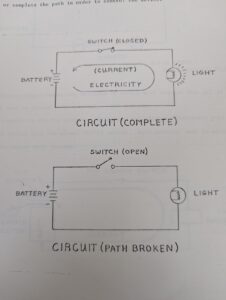
He explains what a circuit is – an unbroken path from one terminal to another of a power source, through which current can flow. A good overview of circuits in series and parallel comes next, including the tip that most simple toy adapters the AT maker will build, will be in series.

Types of switches covered are toggle, rocker, push button, microswitch, rotary, and mercury (tilt) switches.

It’s a very condensed electronics course in about 15 pages! If you walk through it and try the instructions, you will learn enough about how batteries, switches, circuits, and so on work that you can build many adaptive devices.

Have a look: https://archive.org/details/introduction-electric-circuits

a diagram showing a complete and a broken circuit

Leave a Comment

Adding metadata to individual device entries

The DIY information that the GOAT team has been scanning and cataloguing is in book-sized chunks right now. So, you can go to the Internet Archive to our scanned material, and search on a term — for example, “woodworking“, or “clothing” and you’ll be able to view the entire book. 

Our goal, though, is to be able to search for individual devices. Our next project is to pull out those devices and add metadata to them. We’re testing that now on a small scale! Check out the DIY Big Index page. While there are only a few devices there for now, you may be able to see the potential! 

We will end up with an easy way to search for every record we’ve got on how to build a standing frame, a fork extender, or a cup holder. Anyone can then comment on the designs, add photos or links to videos, and so on, to show their own builds and contribute improvements, variations, and other suggestions. 

Those entries don’t have to be limited to information we’ve scanned. We can index and host archive copies from other sources too, and include open source software and hardware projects, like those from OpenMedTech or Open Source Wheelchairs!

We will be hosting an event soon to invite volunteers to help us categorize and label devices. If you’re interested, please comment here or email liz@openassistivetech.org!


Leave a Comment

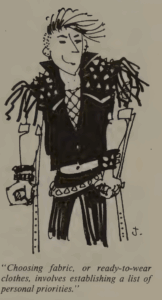
Archive scans: Punk on crutches in a clothing DIY book

ink and pen illustration of person in punk rock gear and a mohawk, with forearm crutches
“Choosing fabric, or ready-to-wear clothes, involves establishing a list of personal priorities”

In our recent scanning and archiving work, I really loved this illustration from a 1987 book, Fabricwise,  on issues to consider when choosing fabrics for adaptive clothing. Really, it’s a good short primer on the pros and cons of different kinds of fabrics and why you might choose them in particular situations.

You might want to think about the tradeoff between a little bit of stretch for your pants if you are sitting in a wheelchair (good for comfort and not having baggy pants; bad for durability).

A quote from the introduction:

An able-bodied person may be able to tolerate clothes made from fabrics which are less than comfortable, crease badly or need a lot of care. For the person with disabilities, any one of these drawbacks, discovered too late, may mean that the clothes are hardly worn.

Correctly chosen fabrics can help minimise some of the problems of people with disabilities; a wheelchair cushion covered in a fabric with a high pile or rough finish may contribute to sitting stability while one with a fabric surface which is smooth may make wheelchair transfers easier. Warm yet lightweight bedding can make sleep more comfortable and getting in and out of bed easier.

It has a lot of ideas like this that seem like common sense when you think about it – but that many people have to find out for themselves. I never thought about using a rougher wheelchair cushion fabric to stop myself from sliding around, but now I want to try it!

Sadly, the book does not magically solve the problem of jacket cuffs fraying on one’s manual wheelchair tires.

But I appreciate the punk representation!!

Leave a Comment

Open data for CPAP machines

OSCAR looks like a great project; well maintained with many different CPAP machines supported. It has a lively community as well at ApneaBoard.

This is another great example of machines we depend on, that are very intimately entwined with our lives, and that produce a lot of data. What data? Where is that data going? Who has access to it? Manufacturers seem to assume that the users of this equipment won’t want or need their own data. But the more open the platform is, the more possible tools we can develop!

OSCAR is an acronym that stands for, “Open Source CPAP Analysis Reporter”. OSCAR provides for the viewing of the high-resolution sleep data that is generated by the CPAP and stored on the SD card. OSCAR converts this data to graph form allowing the user to view this data down to a breath by breath level. OSCAR is free to use and is compiled in formats that will operate on Mac, Linux, and Windows. OSCAR can be downloaded from https://www.sleepfiles.com/OSCAR/. It is this information that enables you to provide data for discussion with your doctor and/or to view and optimize your personal therapy.

OSCAR is also used by many physicians and therapists who consult with patients, and by medical researchers comparing patient/machine responses across multiple platforms. OSCAR provides visual and statistical data details and enables comparisons across machine types and manufacturers, that are not available from proprietary manufacturer software and data products. Professionals who rely on OSCAR to provide research and to serve patient needs will lose this valuable resource if data becomes inaccessible, or only available through the manufacturer’s data products.

Leave a Comment

Report on Love Your Ride workshop

Our February workshop went well – small but fruitful! Unfortunately, I forgot to take photos, but we had a lot of fun!

People liked the maintenance kits and zines, and we all shared stories of our chairs breaking, repair techniques, watching online videos for tips and tricks, and of course, dealing with insurance and trying to source parts for older chairs.

Several new volunteers came to help out, some with bike or car mechanic skills and others just generally handy. Mostly that meant, working one on one with workshop participants to figure out if they could use particular custom tools or parts. Our volunteers (Maureen, Mike, Luis Felipe, Jake, and Olga) were also super helpful in finding service manuals online to email them to device owners!

And, Marisol showed off the Assistive Tech lending library while Vince shared his experiences as a wheelchair repair tech over the years.

One of our William had some amazing sites and resources and knowledge to give us. I’m hoping he will become a GOAT volunteer!

https://brokenwheelchairs.com, which has incredibly useful information about some of the most common powerchairs, like service manuals, sizes of attachment rails, and other great repair adjacent stuff. I am reaching out to the creator of that site to see if GOAT can be helpful to them !

White Raven Mobility, which has 3-D printed joystick and other small modifications available for sale at a fairly low cost – by a wheelchair user who is a maker and inventor!

Build My Wheelchair – A parts and battery shop, not cheap, but sometimes you can find a deal. And what they are really good for, is you can order parts through them, when manufacturers won’t sell direct to you.

MyATProgram – This is a program in several different states that functions as a lending library for assistive tech.

For our actual workshop we passed out the toolkits and zines, and then had a lot of extra tools and parts laid out across some tables for kit customization.

This was a great pilot event that helped me figure out what is workable in an hour and a half to two hours. For our next event, I will have a new version of the zine, and the workshop itself will have a bit more structure.

Rather than one two page spread to write down lots of different pieces of info about the device, I think we need to first frame what we are doing and why!

That means a quick round of simply listing
1. Things that have broken or worn out in the device in the past. NOT a long story – just a list.
2. Things that you wish you could modify about the device in the future. For example, stronger hooks for carrying things on the back of the seat, or a more accurate and informative battery level readout.
3. Who helps you, or might help you, with maintenance and DIY repairs? Who might learn with you and be supportive?

From there, I think we would be more ready to jump into gathering information about the specific device, and have some goals in mind.

We can aim our work at, becoming more prepared for the next time something breaks, or be able to prevent that breakage!

And, at following up later on the things that aren’t broken but that we want to change – like those stronger hook systems!

The other thing I found in our workshop is that, this subject is broad, deep, and powerful. We all as wheelchair users or assistive tech users have strong feelings about our relationship with our equipment. We depend on it like parts of our bodies. When stuff breaks and especially when we run into the enormous problems and limitations of insurance, Medicare, vendors who don’t respond, and so on — or even facing being without our critical devices for weeks or months — It can be a traumatic experience.

So, any wheelchair fixing workshop kind of tends towards story sharing , peer skill sharing, and I would say, a deepening of political awareness and solidarity. None of those stories are things that I want to fend off or interrupt. But, my thought is to make space for them towards the end of a workshop and follow it up with info on how to file complaints, how to use Right to Repair law, and other kinds of advocacy and activism we can use in those difficult situations!

The same thing is true to some extent of any kind of tech support. At least, with some of my old experience in IT, I felt it was so — my job was only partly “fixing computers” and was much more about listening to people, doing a kind of combination of therapy and pedagogy to try to get people to a place of empowerment rather than trauma and fear.

Meanwhile, I ahve great news I’ll talk more about soon, which is that we got some substantial donations! This means we can expand our toolkits and the range of tools we have available, and run more programs, as well as re-doing and expanding the Fix-It Zine.

Our Fix-It Zine in a more general form, version 2, will be available soon to buy or download & print free!
Leave a Comment

DIY archive work

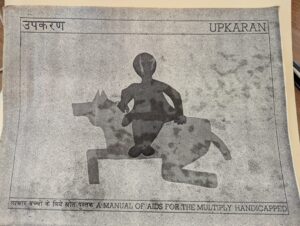
book cover in english and hindi: Upkaran, a manual of aids for the multiply handicapped

GOAT’s Archival team is cataloguing DIY assistive tech material – currently, many boxes of books and papers donated by Alexandra Enders. Many of the books we are going through and scanning are not available in any library and not findable in digital form online – they are unique, and we are so excited to preserve them for future generations, so they can learn, build, use, and invent based on these assistive tech designs!

The team adds each source to our LibraryThing profile, and adds metadata such as keyword tags. Have a look at our current catalog.

The material is then scanned and uploaded to GOAT’s account on the Internet Archive, freely available to anyone around the world to read.

As we go through the 20 or so donated boxes, we will be moving the source material when appropriate to the Prelinger Library in San Francisco, which has agree to host our physical copies that are unique, rare, or important. These hard copies to be accessible to the public, so that people can visit, browse, and read elements of this important collection in person.

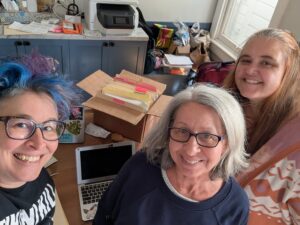
Thanks to our Archiving team: Veronica, Karen, Milo, and Jack!

liz, karen, and veronica smiling in front of a box of papers, a scanner, and laptop

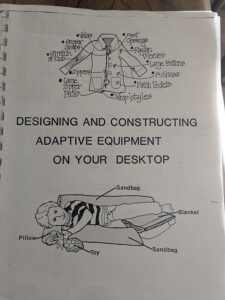
Book cover: Designing and Constructing Adaptive Equipment on your desktop. diagram of child lying on adaptive pillows, design of overcoat with adaptive fastenings

Leave a Comment